Updated September 2026. Prices checked September 2026.
A carousel only works if you can keep making them. Most design tools handle the slides. Fewer help with the parts that take the time: writing the copy, writing the caption, and getting the post out on schedule every week.
This guide compares five tools for creating social media carousels: Contentdrips, Canva, Adobe Express, Visme and Taplio. We look at what each one costs, what its free plan includes, and how much of the carousel workflow it covers. Contentdrips is one of the five. We’re a competitor, so we say plainly where each tool, Contentdrips included, is the better pick.
What to look for in a carousel tool
- Templates and sizes made for social posts, so you’re not resizing by hand
- AI carousel generation from a topic, some text or a link
- A brand kit that keeps every carousel on-brand
- Captions and post copy, written for the platform you’re posting to
- Scheduling or direct publishing to LinkedIn and Instagram
- Repurposing, meaning turning a blog post or video you already have into carousels
- The right export formats. LinkedIn carousels are uploaded as PDFs, and Instagram uses images.
The five tools at a glance
| Tool | Best for | Starting price | Free plan |
|---|---|---|---|
| Contentdrips | Turning blogs and videos into carousels and posts | $15/mo (Starter) | 7-day trial with 50 AI credits |
| Canva | All-round design | $144/year for Pro (about $12/mo) | Yes |
| Adobe Express | Design with a built-in scheduler | $9.99/mo (Premium) | Yes |
| Visme | Presentations, infographics and data visuals | $12.25/mo billed annually (Starter) | Yes, limited, with a watermark |
| Taplio | LinkedIn growth and analytics | $39/mo | 7-day trial |
Prices are in USD and change often, so check each vendor’s pricing page before you buy.
1. Contentdrips: best for turning content you already have into carousels and posts
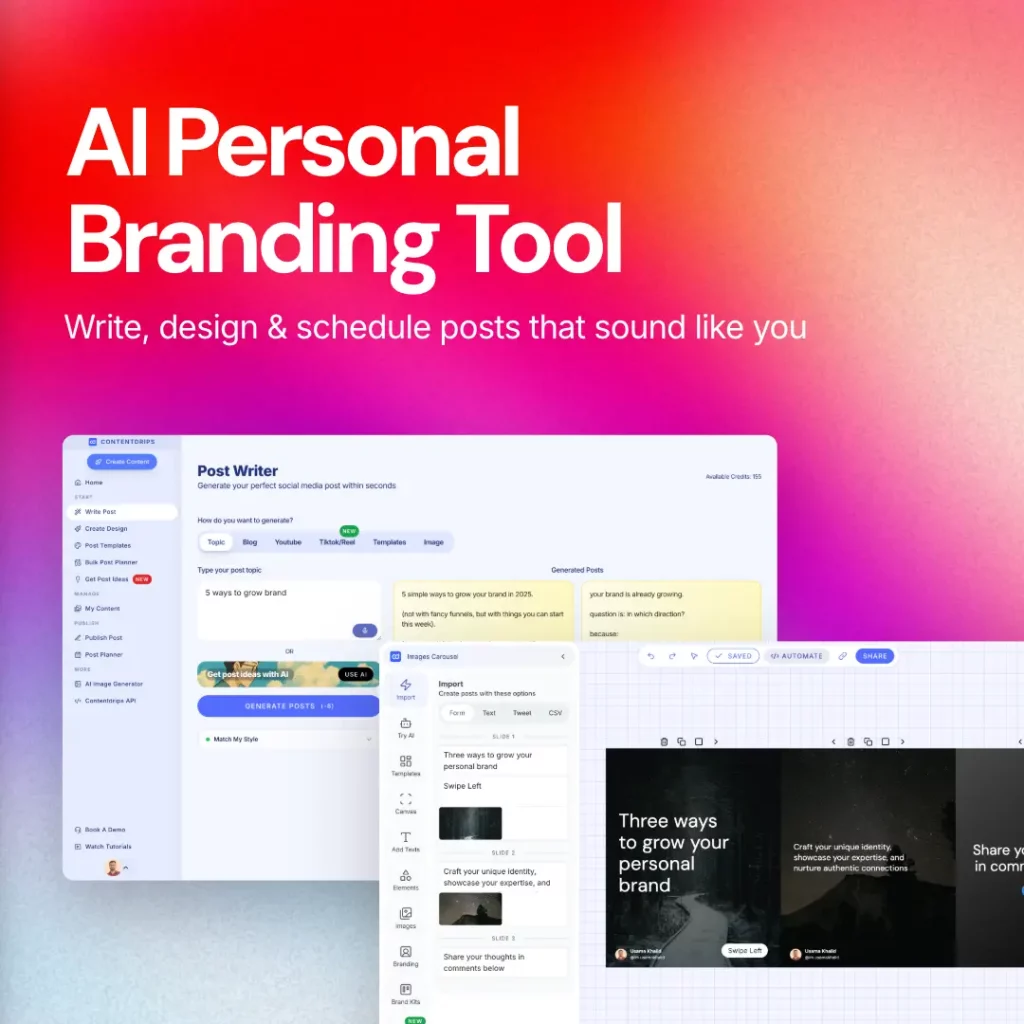
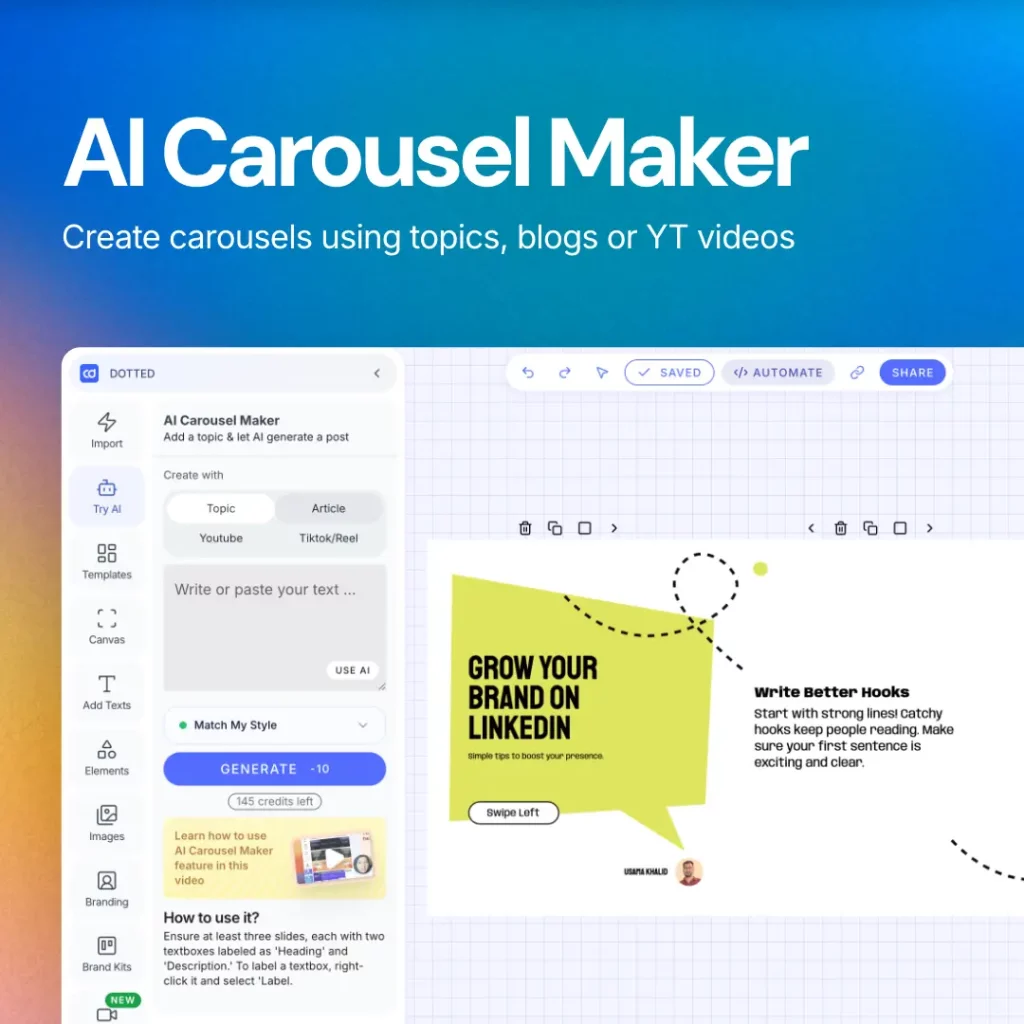
Contentdrips is built for social posts rather than general design. Paste a topic, some text, a blog URL, or a YouTube, TikTok, Reel or Short link, and it repurposes it into a carousel, graphic or text post. The result is adapted to the platform you’re publishing to (caption, format and size) and designed in your brand kit. It also writes LinkedIn posts, suggests post ideas, and can generate a whole batch of carousels from a spreadsheet. You can schedule to LinkedIn and Instagram from the same dashboard, and export as a PDF for LinkedIn, PNG for Instagram, or MP4 and GIF for animated posts.
Starter is $15 a month and includes 1,500 AI credits, 3 brands, 2 collaborators and 2 social channels. An AI carousel costs 10 credits and a blog or YouTube conversion costs 15, so Starter covers roughly 100 to 150 generations a month. Pro is $29 a month and adds all social channels including TikTok, unlimited brands and team members, and API access. You can try it first with a 7-day free trial that includes 50 AI credits.
- Good for: Creators, consultants and agencies who repurpose blogs and videos into LinkedIn and Instagram content and want to post consistently without designing every slide by hand.
- Watch out for: It is not a general design suite, so keep Canva (the Free plan is often enough) for presentations and print. AI actions use credits, so heavy users may need Pro.
See how it compares in our Contentdrips vs Canva comparison, or try the AI carousel maker.
2. Canva: best all-round design tool
Canva builds carousels as multi-page designs from templates, and its AI can generate designs and text from a prompt. A third-party Carousel Studio app in Canva’s app marketplace also generates Instagram carousels from a prompt. Pro is $144 a year (about $12 a month) and includes 5 Brand Kits, social content scheduling and Canva’s AI tools such as resize and background remover. The Free plan includes 1 Brand Kit (limited to three colors), 5 GB of storage and up to 20 AI uses.
- Good for: People who make more than social posts and want presentations, print, video and docs in the same tool.
- Watch out for: Canva’s plan features list AI design and writing tools, bulk creation and scheduling, but not turning a blog post or video into a finished carousel and caption. Social content scheduling is listed as a Pro feature.
- How Contentdrips fills the gap: Contentdrips is specialized for repurposing. Paste a blog post, or a YouTube, TikTok, Reel or Short link, and it turns it into a carousel, graphic or text post adapted to the platform you’re publishing to (caption, format and size), all in your brand kit. Then it schedules to LinkedIn and Instagram.
Looking for cheaper options? See our guide to the best Canva alternatives for social media posts.
3. Adobe Express: best design tool with a built-in scheduler
Formerly Creative Cloud Express, and before that Adobe Spark.
Adobe Express builds carousels with a multi-page editor and templates. Premium is $9.99 a month billed monthly with no annual commitment, and adds premium templates, brand kits, Firefly AI tools, 100 GB of storage and 250 generative credits a month. The Free plan includes 5 GB of storage and a limited AI allowance. Adobe also includes a Content Scheduler that publishes to LinkedIn, Instagram, Facebook, TikTok, Pinterest and X on the free plan, an AI caption writer, and bulk creation from a CSV.
- Good for: People who want a familiar template editor with scheduling built in, especially if they already use Adobe apps.
- Watch out for: Adobe’s AI is general-purpose. The caption writer drafts a caption from a short description or an image, and carousels are built from templates and the multi-page editor. Neither starts from a blog post or a video, so repurposing content you already have is manual.
- How Contentdrips fills the gap: Contentdrips starts from your source material. Paste a blog post or a video link and it writes the slide copy, designs the carousel in your brand kit and drafts the caption for the platform you’re posting to, then schedules it.
See our Contentdrips vs Adobe Express comparison.
4. Visme: best for presentations, infographics and data visuals
Visme covers 100+ content types, with social carousel templates alongside presentations, reports and infographics. Its AI Designer turns a text prompt into an editable design, and its Brand Wizard applies your brand styles across templates. Starter is $12.25 a month billed annually ($147 a year) and removes the watermark, and Pro is $24.75 a month billed annually. The free plan is limited and exports carry a watermark.
- Good for: Teams that make carousels alongside presentations, reports and data-heavy visuals.
- Watch out for: The AI Designer works from a text prompt rather than from a blog post or video you already have, and the platform is much broader than social posts.
- How Contentdrips fills the gap: Contentdrips is built only for social posts. It starts from the content you already have, writes the slides and the caption, and exports a PDF for LinkedIn or PNG for Instagram.
5. Taplio: best for LinkedIn growth and analytics
Taplio is a LinkedIn-only tool that combines AI post writing, a carousel generator, scheduling, analytics and engagement tools. Plans start at $39 a month, and it offers a 7-day free trial with full Pro access. Several 2026 reviews report that the entry plan has no AI credits and that AI writing and carousel generation start on the Growth plan, at about $65 to $69 a month billed monthly.
- Good for: LinkedIn-first creators and sales professionals who want analytics and engagement tools alongside posting.
- Watch out for: It covers LinkedIn only, and reviews say the AI features sit on a higher plan than the entry price.
- How Contentdrips fills the gap: Contentdrips covers Instagram as well as LinkedIn (and TikTok on Pro), and designs the graphics and carousels in your brand kit. Starter at $15 a month includes the AI carousel generator and post writer.
See our Contentdrips vs Taplio comparison.
Which carousel tool should you pick?
- Turning blogs and videos into carousels and posts: Contentdrips.
- One tool for everything, not just social: Canva.
- Design plus scheduling at a lower monthly price: Adobe Express.
- Carousels alongside presentations and infographics: Visme.
- LinkedIn analytics and engagement: Taplio.
Many creators pair two tools, for example Canva for presentations and Contentdrips for the social posting workflow.
Frequently asked questions
What is the best tool for social media carousel design?
It depends on your workflow. Contentdrips is built for turning existing content into carousels and posts. Canva and Adobe Express are better all-round design tools, and Taplio is best if you only post on LinkedIn and want analytics.
Can Canva make carousels?
Yes. Canva builds carousels as multi-page designs from templates, and its AI and marketplace apps can generate carousels from a prompt. For LinkedIn you export the carousel as a PDF.
Can I turn a blog post into a carousel?
Yes. With Contentdrips you paste the blog URL and it generates the carousel and caption. Taplio can also turn content into carousels, but only for LinkedIn.
What format do I need for a LinkedIn or Instagram carousel?
LinkedIn carousels are uploaded as PDF documents, and Instagram carousels use images such as PNG. Contentdrips exports both, plus MP4 and GIF for animated posts.
Is there a free carousel maker?
Canva Free and Adobe Express Free both let you build carousels. Contentdrips offers a 7-day trial with 50 AI credits rather than an ongoing free plan, and Visme’s free plan adds a watermark.
What replaced Adobe Spark?
Adobe Spark became Creative Cloud Express and is now Adobe Express.
How we compared these tools
We checked prices and features on each vendor’s pricing and help pages and against current 2026 reviews in September 2026. Canva’s pricing page shows the annual price by default. Contentdrips is a competitor in this list. Plans change often, so confirm current pricing with each vendor before you buy.
Want to see how Contentdrips compares against more tools? Browse all our comparisons.
In a world where 4.76 billion people are online and visual content drives over 90% of user interaction, choosing the right social media design tools is crucial.
In this comparison of Contentdrips vs. social media design tools, we’ll explore how Contentdrips stacks up against top competitors like Canva, Adobe Spark, Visme, and Taplio. Discover why Contentdrips might be your ultimate choice for elevating your social media presence.