We make Contentdrips, so it’s on this list. We’ve tried to be straight about where it fits and where it doesn’t. Prices checked September 2026.
Choosing a LinkedIn scheduler mostly comes down to three questions:
- Do you want a LinkedIn-only tool or one that covers several platforms?
- Do you need help writing and designing posts, or only scheduling them?
- Are you paying per user, per channel, or a flat fee?
Quick picks
| If you want… | Pick |
|---|---|
| A free option | LinkedIn’s native scheduler (Buffer Free if you need more platforms) |
| To write, design, and schedule from inside Claude, ChatGPT, or another AI assistant | Contentdrips (Pro plan) |
| Write, design, and schedule in one place | Contentdrips |
| LinkedIn growth and engagement tools | Taplio |
| A budget LinkedIn-only tool with AI writing | Supergrow |
| Simple multi-platform scheduling | Buffer |
| Large teams and enterprise workflows | Hootsuite |
How to choose a LinkedIn scheduler
- Official API connection. Tools that publish through LinkedIn’s official API are the safe choice. Tools that use browser automation, scraping, or stored logins are the ones LinkedIn’s terms prohibit.
- Editable queue. LinkedIn’s native scheduler doesn’t let you edit a scheduled post. A dedicated tool should.
- Bulk scheduling. If you post more than a couple of times a week, queueing a week or two at once saves the most time.
- Pricing model. Some tools charge per channel (Buffer), some per user (Hootsuite), and some by credits or plan tier (Contentdrips, Taplio, Supergrow). Compare what you’d actually pay for your setup, not the headline price.
- AI-assistant (MCP) support. If you already pay for Claude or ChatGPT, check whether a tool connects to your assistant, and what the assistant can actually do once connected. Some let it draft and queue text. Fewer let it design the visuals too.
1. Contentdrips
Best for: creators and small teams who want to write, design, and queue posts in one tool, including people who do most of their work inside Claude or ChatGPT. Pricing: Starter $15/mo, Pro $29/mo, Ultimate $52/mo (billed monthly). A 7-day trial includes 50 credits.
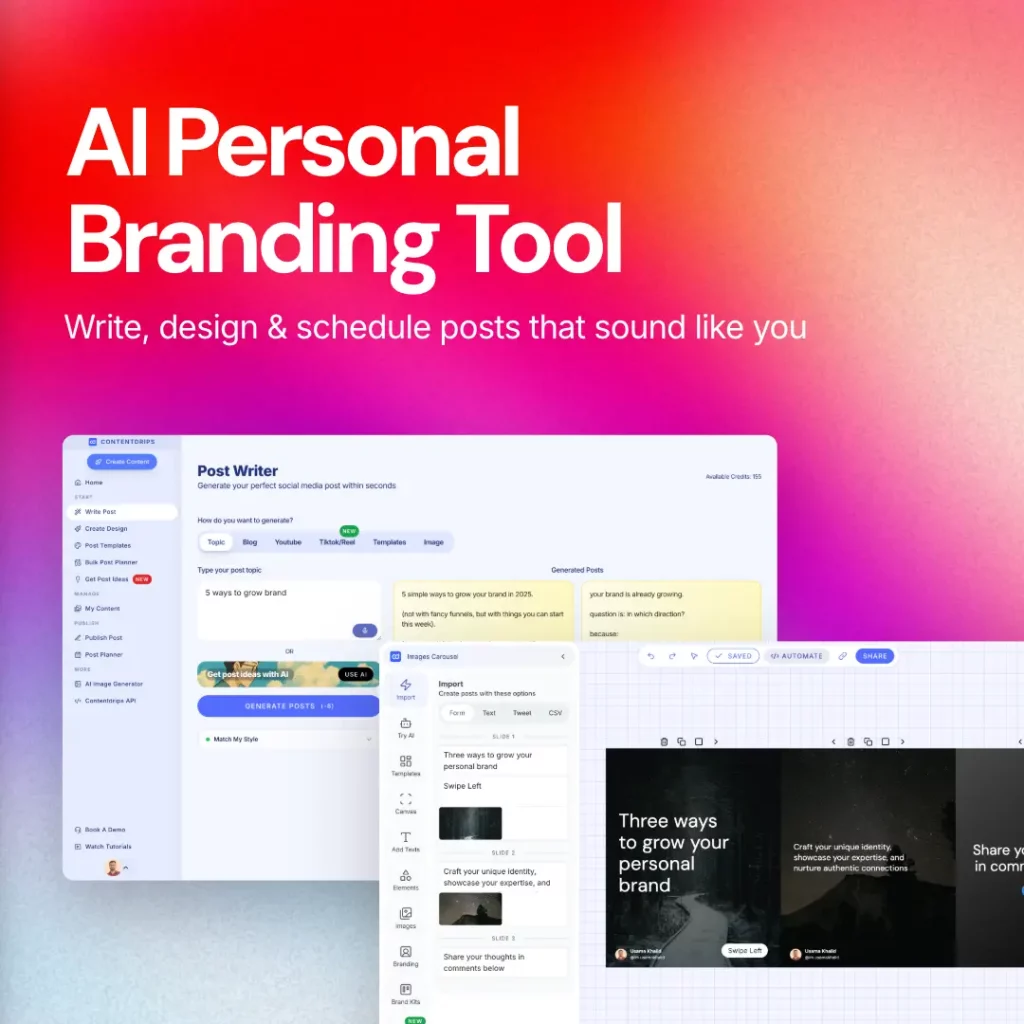
You draft with an AI post writer, design the visual by chatting with an AI design agent, and queue everything on a calendar. Starter includes 2 social channels, 2 collaborators, and 3 brands. Pro adds LinkedIn, Instagram, and TikTok, unlimited brands and team members, and API and MCP access. Credits are shared across features: an AI carousel costs 10 credits, so Starter’s 1,500 monthly credits cover roughly 150 of them.
Compared with a scheduling-only tool, the entry price is higher because it includes AI writing, design tools, and credits. Contentdrips’ $15 and Buffer’s $6 don’t buy the same thing.
Write, design, and schedule from inside your AI assistant
If you already pay for Claude, ChatGPT, or another AI assistant, you don’t have to leave it. Connect Contentdrips through MCP and a single conversation can take you from raw material to a scheduled post: the assistant writes the caption, designs the graphic or carousel in your brand template, and queues the finished post.
An example prompt: “Turn this YouTube video into a LinkedIn carousel in my brand template, write the caption, and schedule it for Thursday at 8am.”
Several schedulers now let an AI assistant draft and queue text posts. Taplio’s own documentation, for example, says its MCP writes text posts and can’t create images or carousels. With Contentdrips, your assistant doesn’t stop at the caption. It designs the visuals and schedules the finished post in the same session, with no tab-switching and no copy-pasting.
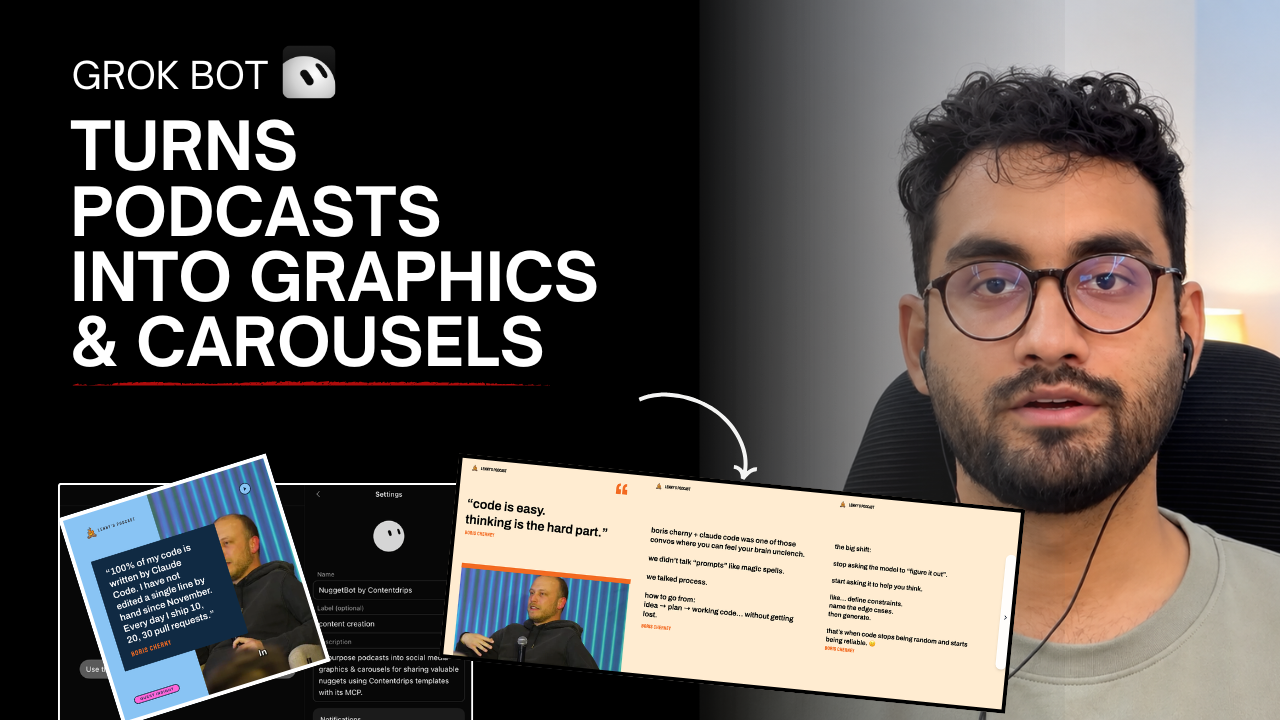
Setup takes a few minutes: add the Contentdrips MCP server in your assistant’s connector settings and authorize it with your API key. MCP and API access start on the Pro plan ($29/mo). Starter has no API access. Step-by-step guides: Contentdrips MCP, Claude, OpenClaw, and Grok Bot.
Pros
- Writing, design, and scheduling in one place
- Bulk planning of up to two weeks at once
- Connects only through LinkedIn’s official API: no scraping, no browser extensions, no stored passwords
- Works from inside Claude, ChatGPT, and other MCP-compatible assistants, and the assistant can design the graphics as well as write and schedule
Cons
- No permanent free plan (there is a 7-day trial)
- MCP and API access require the Pro plan ($29/mo)
- Usage is credit-based
- Not LinkedIn-only, so it isn’t a specialist in LinkedIn analytics
If you want to see how it works, try the LinkedIn scheduler. Comparing it with a specific tool? See the Taplio alternative and Supergrow alternative pages.
2. LinkedIn’s native scheduler
Best for: occasional posting at no cost. Pricing: Free.
LinkedIn lets you schedule a post from about 10 minutes to 3 months ahead, on both personal profiles and company pages.
Pros
- Free, with nothing to connect or install
- Works for both profiles and company pages
Cons
- Scheduled posts can’t be edited (you delete and recreate them)
- One post at a time, with no bulk upload
- No shared calendar or team handoff
- Polls, events, and jobs can’t be scheduled
3. Buffer
Best for: simple scheduling across several platforms. Pricing: Free for 3 channels. Essentials $6 per channel/month ($5 if billed yearly). Team $12 per channel/month ($10 if billed yearly).
Buffer bills per channel, not per user. A LinkedIn profile and a LinkedIn company page count as two channels. Team adds unlimited users and approval workflows. Buffer has also added an API with a hosted MCP server for AI assistants, though it has no built-in design tools.
Pros
- Easy to use
- A usable free plan
- Covers many platforms
Cons
- Cost grows with every channel you connect
- Not LinkedIn-specific
- No AI design tools
4. Taplio
Best for: LinkedIn-focused creators who want growth and engagement features. Pricing: Starter $39/mo, Standard $65/mo, Pro $199/mo, with up to 25% off yearly and a 7-day trial.
Taplio is LinkedIn-only, with scheduling, analytics, AI writing, and lead tools. The entry plan has no AI credits, so check which plan includes the AI features you want. Taplio also offers an MCP that works with Claude and ChatGPT to draft posts, schedule them, and read analytics, and it requires a paid Taplio account.
Pros
- Built specifically for LinkedIn
- Deep engagement tooling
- MCP for Claude and ChatGPT that drafts, schedules, and reads analytics
Cons
- Priced higher than most tools here
- Easy to overpay for if you only need scheduling
- Per its own documentation, the MCP is text-focused and can’t create images or carousels
- Includes automation features (auto-connect and DMs), which are riskier to use because LinkedIn restricts third-party tools that automate activity on its site
5. Supergrow
Best for: solo LinkedIn creators on a budget. Pricing: Starter $19/mo, Pro $39/mo (includes the carousel builder), Teams $139/mo. No free plan, 7-day trial.
Pros
- Low entry price
- AI trained on your own writing voice
Cons
- LinkedIn-only
- Lighter analytics than Taplio
6. Hootsuite
Best for: larger teams that need approvals and reporting across many accounts. Pricing: Standard $99, Professional $199, Advanced $399, each per user per month billed annually. No free plan.
Approval workflows arrive at the Advanced tier, and every added user pays the full per-seat price.
Pros
- Enterprise features
- Broad platform coverage
Cons
- The most expensive option here
- Priced per seat, so team costs climb quickly
Which should you choose?
If you only post now and then, start with LinkedIn’s free scheduler. If you post several times a week and want help with writing and design, try Contentdrips. If your workflow already lives inside Claude or ChatGPT, Contentdrips on the Pro plan is the one that lets that same session write the caption, design the graphics, and schedule the post. Choose Taplio if LinkedIn growth tooling is your priority, and Buffer if you juggle several platforms on a budget. Hootsuite is for teams that need approvals and reporting.