Someone finally asks you to write them a LinkedIn recommendation. You open the box. Your mind goes completely blank. Sound familiar? This guide fixes that with 50+ copy-paste templates organized by role, relationship, and industry.
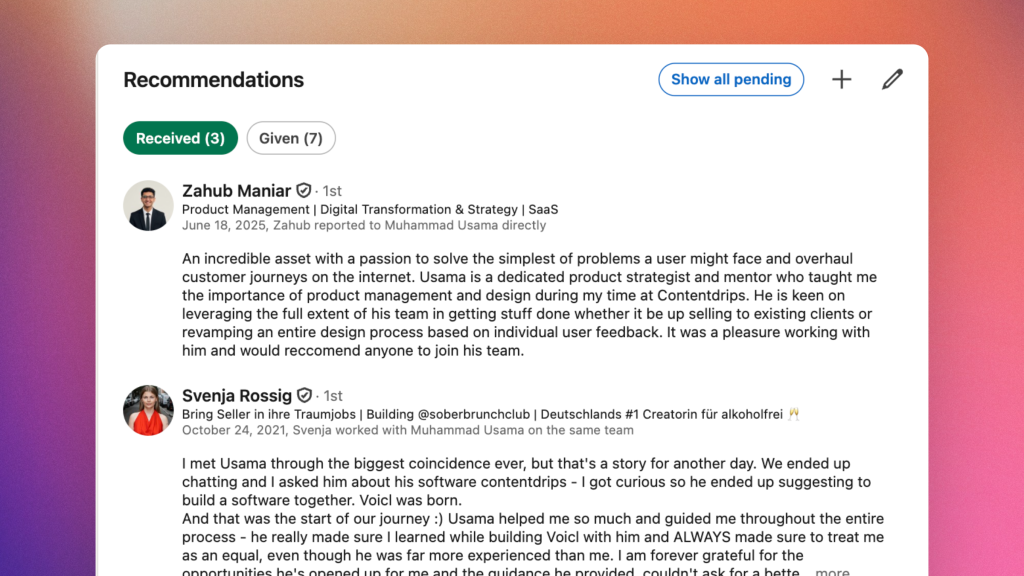
Why LinkedIn Recommendations Actually Matter
Before you skip to the templates, here is the data that makes recommendations worth your time.
Profiles with three or more recommendations receive significantly more profile views and recruiter messages than profiles without any. And 87% of recruiters actively use LinkedIn to research candidates during hiring, meaning your recommendations are being read by real decision-makers.
A well-written recommendation does three things a bullet point on your profile cannot:
- It shows proof, not just claims. Anyone can say they are “results-driven.” A manager writing “she increased our pipeline by 40% in Q1” is a different thing entirely.
- It tells a story. Stories are memorable. Lists of skills are not.
- It builds trust through association. A strong recommendation from a credible person transfers some of their credibility to you.
The challenge is that most people either do not have recommendations, or the ones they have are too generic to be useful. This guide is here to change that.
The 4-Part Formula Behind Every Strong Recommendation
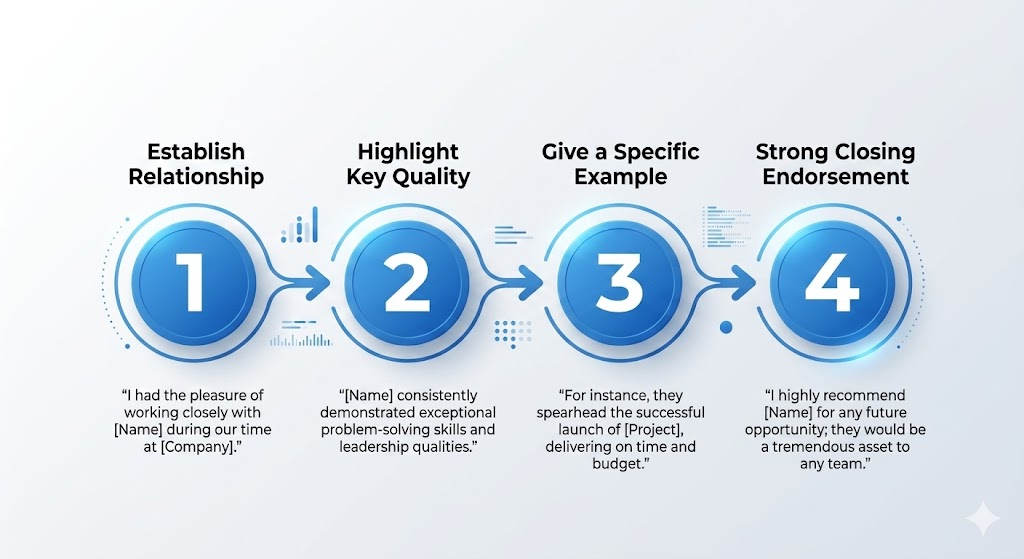
Before jumping into templates, understand what makes a recommendation work. Every strong LinkedIn recommendation has four components:
1. Establish the relationship Who are you, and how do you know this person? This gives the reader context to weigh your opinion. “I managed [Name] directly for two years on our enterprise sales team at [Company].”
2. Name one or two standout qualities Not a list of every positive adjective. Pick the one or two traits that define them professionally. “What sets [Name] apart is their ability to turn complicated data into decisions the whole team can act on.”
3. Prove it with a specific example or result Generic claims get ignored. Specifics get remembered. “During our product launch in Q3, [Name] led a cross-functional team of eight and delivered three weeks ahead of schedule.”
4. Close with a clear, confident endorsement End with something that tells the reader exactly what you think. “I would hire [Name] again without hesitation and recommend them for any senior leadership role.”
Keep your recommendation between 100 and 200 words. Long enough to be credible, short enough to actually be read.
50+ LinkedIn Recommendation Examples by Role
Use these templates as your starting point. Replace the bracketed details, adjust the tone to fit your voice, and add a real specific detail wherever you can.
For a Colleague / Coworker
These recommendations come from peers. They tend to focus on collaboration, reliability, and day-to-day professionalism.
Template 1 (General colleague) “I worked alongside [Name] at [Company] for [X years], and they are one of the most dependable people I have had the pleasure of collaborating with. [He/She/They] consistently brought clarity to ambiguous projects and always made the people around them better. If you get the chance to work with [Name], take it.”
Template 2 (Colleague, project-specific) “[Name] and I worked together on [project name] at [Company]. While the timeline was tight and the scope kept shifting, [he/she/they] stayed focused and delivered work that genuinely moved the needle. Their ability to stay calm under pressure is something I have not seen often in my career.”
Template 3 (Colleague, teamwork focus) “Few people make a team better just by being in the room, but [Name] is one of them. At [Company], [he/she/they] consistently elevated every project [he/she/they] touched, from early brainstorms to final delivery. I could always count on [Name] to follow through, no matter the deadline.”
Template 4 (Colleague, creative/marketing) “I had the pleasure of working with [Name] on our marketing team at [Company]. [His/Her/Their] creative instincts are sharp, but what really makes [him/her/them] stand out is [his/her/their] ability to tie creative decisions back to real business goals. [Name] made our campaigns smarter.”
Template 5 (Colleague, technical) “[Name] is the kind of engineer who does not just write clean code but also takes time to make sure the whole team understands what they built and why. Working with [him/her/them] at [Company] taught me a lot, and I would jump at the chance to collaborate again.”
For a Manager / Boss
You are writing upward here. The tone is respectful and specific, focused on leadership impact.
Template 6 (General manager) “[Name] was my manager at [Company] for [X years], and I credit much of my professional growth during that period to [his/her/their] leadership. [He/She/They] led with clarity, gave honest feedback, and genuinely cared about the development of everyone on the team. I would work for [Name] again without question.”
Template 7 (Manager, strategic leadership) “Working under [Name] at [Company] meant operating at a level I did not know I was capable of. [He/She/They] had a rare ability to set a clear strategic direction and then give the team the autonomy to execute. Our team delivered [specific result] during [his/her/their] tenure, and [Name] was central to making that happen.”
Template 8 (Manager, mentorship focus) “[Name] is not just a strong manager but a genuine mentor. During my time on [his/her/their] team at [Company], [he/she/they] invested real time in my development, giving me stretch projects and honest feedback that helped me grow faster than any previous role. I cannot recommend [Name] highly enough.”
Template 9 (Manager, team culture) “What stands out most about [Name] as a leader is the culture [he/she/they] built. When I joined [Company], the team was fragmented. Within six months of [Name] taking over, we were one of the highest-performing teams in the organization. That kind of transformation does not happen by accident.”
Template 10 (Manager, results-driven) “Under [Name]’s leadership, our team consistently hit targets that had seemed out of reach before [he/she/they] arrived. [Name] brought a focus on metrics and accountability that sharpened how we all worked, without ever losing the human side of leadership. A genuinely outstanding manager.”
For a Direct Report (Manager Writing About a Team Member)
These recommendations come from authority. Be specific about what this person contributed and why you trust them.
Template 11 (General direct report) “I managed [Name] directly at [Company] for [X years], and [he/she/they] was one of the most reliable contributors I have overseen in my career. [He/She/They] took ownership of [specific area], consistently delivered results, and made [his/her/their] teammates better in the process. Any manager would be lucky to have [Name] on their team.”
Template 12 (Direct report, high performer) “[Name] joined our team at [Company] as a [role] and quickly became one of our top contributors. In [his/her/their] first year, [he/she/they] [specific achievement]. [Name] is the kind of person who raises the standard of everyone around them, and I promoted [him/her/them] twice before [he/she/they] moved on. I cannot recommend [Name] strongly enough.”
Template 13 (Direct report, leadership potential) “[Name] has the rarest combination of technical skill and emotional intelligence. As [his/her/their] manager at [Company], I gave [him/her/them] increasingly complex challenges and [he/she/they] delivered every time. More importantly, [Name] has a natural ability to lead others without needing a formal title to do it.”
Template 14 (Direct report, problem solver) “When I think about [Name]’s time on my team at [Company], what stands out most is [his/her/their] problem-solving ability. [He/She/They] did not bring me problems, [he/she/they] brought me options. That mindset is rare and valuable, and it made a real difference to how our team operated.”
Template 15 (Direct report, leaving on good terms) “Losing [Name] was one of the hardest parts of that chapter for our team, but watching [him/her/them] take on a bigger challenge was genuinely exciting. During [his/her/their] time at [Company], [Name] delivered [specific achievement] and became someone the entire team relied on. Whoever hires [him/her/them] next is getting someone exceptional.”
For an Intern
These are usually shorter and focus on potential, attitude, and what surprised you about this person.
Template 16 (General intern) “[Name] joined us as an intern at [Company] and made an impression within the first two weeks. [He/She/They] approached every task with curiosity, asked the right questions, and delivered work that went well beyond what we expected for someone at that stage. We offered [him/her/them] a full-time role before the internship ended.”
Template 17 (Intern, academic to professional) “I had the pleasure of mentoring [Name] during [his/her/their] internship at [Company]. What struck me most was how quickly [he/she/they] made the transition from academic thinking to practical execution. [Name] is sharp, adaptable, and genuinely eager to learn. Any organization would benefit from giving [him/her/them] a shot.”
Template 18 (Intern, initiative) “[Name]’s internship with us at [Company] was defined by one word: initiative. Without being asked, [he/she/they] [specific example of going beyond the brief]. That kind of instinct does not come from a textbook, and it tells you everything about [Name]’s professional future.”
Template 19 (Intern, technical role) “When [Name] joined our engineering team as an intern, we were honestly unsure how much they would be able to contribute to live projects. Within two weeks, [he/she/they] was shipping code that went into production. [Name] has a technical foundation and a learning pace that are both well above average.”
For a Client or Customer
You are writing as someone who paid for this person’s work. Focus on outcomes, trust, and whether you would hire them again.
Template 20 (General client recommendation) “I hired [Name] to [specific service] for [Company], and the experience exceeded every expectation. [He/She/They] delivered on time, communicated clearly throughout, and the result [specific outcome]. I have already recommended [Name] to two other people in my network and will continue to do so.”
Template 21 (Client, long-term relationship) “I have worked with [Name] across three separate projects over [X years], which says everything about the quality of [his/her/their] work. [He/She/They] is not just skilled but genuinely easy to work with: responsive, honest, and committed to delivering results that matter. I consider [Name] a trusted partner.”
Template 22 (Client, agency or consultant) “[Name] and [his/her/their] team at [Company] handled our [marketing/branding/strategy] and delivered results we still talk about. [Specific result]. More importantly, [Name] took the time to understand our business before recommending anything, which is rarer than it should be.”
Template 23 (Client, service provider) “Working with [Name] removed a significant burden from our team. [He/She/They] handled [specific scope] with professionalism, skill, and real attention to detail. If you are looking for someone who will treat your project like it is the only one on their plate, [Name] is that person.”
For a Mentor
These recommendations come with warmth and personal gratitude. Keep them genuine.
Template 24 (General mentor) “[Name] has been one of the most important professional influences in my career. When I was navigating [specific challenge], [he/she/they] offered perspective, honesty, and practical guidance that genuinely changed my trajectory. I am a better professional because of [Name], and I could not recommend [him/her/them] more highly.”
Template 25 (Mentor, formal program) “I was paired with [Name] through [program name] and consider myself extremely lucky. [He/She/They] brought real depth to every conversation, asked questions that made me think differently, and shared experiences from [his/her/their] own career that I continue to draw on. A brilliant mentor and an even better person.”
For a CEO or Senior Executive
These recommendations need to reflect leadership at scale. Specificity about business impact matters most here.
Template 26 (CEO, investor or board perspective) “I have worked with many founders and executives over my career, and [Name] stands out for one reason: [he/she/they] combines bold vision with disciplined execution. Under [his/her/their] leadership, [Company] achieved [specific milestone]. [Name] is the kind of leader who attracts great people and keeps them.”
Template 27 (CEO, team perspective) “As a member of [Name]’s leadership team at [Company], I had a front-row seat to what exceptional executive leadership looks like. [He/She/They] set clear direction, stayed connected to the work, and built a culture where people genuinely wanted to perform. [Name] made the whole organization better.”
Template 28 (Senior executive, general) “[Name] is one of the most effective senior leaders I have had the pleasure of working under. [His/Her/Their] ability to align a large organization around a clear strategy is matched only by [his/her/their] ability to attract and develop exceptional talent. Any organization would be fortunate to have [Name] at the helm.”
For a Freelancer or Contractor
Reliability, quality of work, and communication are the three things hiring managers want to know.
Template 29 (Freelancer, general) “I hired [Name] on a contract basis for [specific project] and would not hesitate to work with [him/her/them] again. [He/She/They] delivered exactly what was scoped, met every deadline, and communicated proactively throughout. In a world where that is not always a given, [Name] stands out.”
Template 30 (Freelancer, creative) “[Name] brought our brief to life in ways we did not anticipate. [He/She/They] went beyond the deliverables to understand what we were really trying to achieve, and the result [specific outcome]. We have brought [Name] back for two more projects since and plan to continue.”
Template 31 (Freelancer, technical) “I brought [Name] in to help us with [specific technical challenge], and [he/she/they] resolved it faster and more cleanly than we had hoped. [Name]’s technical depth is matched by [his/her/their] ability to communicate clearly with non-technical stakeholders, which made the whole engagement smooth.”
For a Sales Professional
Focus on numbers, relationships, and the ability to represent the company well.
Template 32 (Sales, general) “[Name] was one of the strongest sales performers I worked with at [Company]. [He/She/They] consistently hit [his/her/their] quota and was among our top [percentage] for [timeframe]. But what made [Name] exceptional was not just the numbers. [He/She/They] built real relationships with clients that turned into long-term accounts.”
Template 33 (Sales, new business) “[Name] has a talent for opening doors. During [his/her/their] time on our team at [Company], [he/she/they] brought in [specific number or result] in new business, including several accounts that are still among our top clients today. [Name] is relentless, personable, and genuinely great at what they do.”
Template 34 (Sales, enterprise) “[Name] managed some of our most strategic accounts at [Company], and the results speak for themselves. [He/She/They] grew [his/her/their] book of business by [percentage] in [timeframe], largely through careful relationship-building and a genuine understanding of the client’s business. I would want [Name] on any sales team I run.”
For a Software Engineer or Developer
Specificity about technical skills, teamwork, and ownership matters here.
Template 35 (Engineer, general) “I worked with [Name] on our engineering team at [Company] for [X years]. [He/She/They] is one of the most thorough and thoughtful developers I have collaborated with. [Name]’s code is clean, [his/her/their] documentation is excellent, and [he/she/they] never ships something [he/she/they] does not fully understand.”
Template 36 (Engineer, senior/lead) “[Name] led our backend team through a major infrastructure migration that had been delayed for two years before [he/she/they] took it on. [He/She/They] delivered the entire migration in [timeframe] with zero downtime. That kind of technical and project leadership is genuinely rare.”
Template 37 (Engineer, team fit) “Beyond the technical ability, which is exceptional, [Name] is the kind of engineer every team needs. [He/She/They] mentors junior developers, writes documentation without being asked, and always brings a practical perspective to architectural decisions. [Name] made our entire team better.”
For a Marketing Professional
Tie results to campaigns and show the blend of creative and analytical thinking.
Template 38 (Marketing, general) “[Name] led our content strategy at [Company] and delivered results that changed the direction of the business. Under [his/her/their] leadership, our organic traffic grew by [percentage] in [timeframe], and our lead quality improved measurably. [Name] is that rare combination of creative and analytical that every marketing team needs.”
Template 39 (Marketing, brand) “I have worked with a lot of brand marketers over my career, and [Name] is among the best. [He/She/They] has a natural ability to understand what a brand stands for and translate it into content that resonates. The campaign [Name] led at [Company] resulted in [specific outcome] and remains a benchmark for us.”
Template 40 (Marketing, paid/growth) “[Name] managed our paid acquisition strategy at [Company] and was methodical, creative, and results-focused in equal measure. [He/She/They] brought our cost per acquisition down by [percentage] while scaling monthly spend significantly. I would work with [Name] again immediately.”
For a Customer Success or Account Manager
Retention, relationships, and the ability to navigate difficult client moments are the focus.
Template 41 (Customer success, general) “[Name] managed some of our most important client relationships at [Company], and the retention numbers show it. [He/She/They] has a genuine talent for making clients feel heard and delivering on commitments, which is what this role is really about. I cannot recommend [Name] enough to any team that values client relationships.”
Template 42 (Account manager, upsell) “[Name] grew [his/her/their] accounts at [Company] by an average of [percentage] year over year, not through pressure, but through understanding client needs deeply enough to offer solutions that actually helped them. That is the kind of account management that builds long-term partnerships.”
For a Designer (UX/Visual/Graphic)
Focus on the combination of craft, user empathy, and collaboration.
Template 43 (Designer, general) “[Name] led design on our core product at [Company], and the impact was immediate and lasting. [He/She/They] brought both exceptional craft and a sharp understanding of user behavior to every decision. Our user satisfaction scores improved significantly after [Name] joined the team.”
Template 44 (Designer, brand) “[Name] redesigned our brand identity from the ground up, and the result was exactly what we needed. [He/She/They] took time to understand the business before touching anything, which meant the final work was not just beautiful but strategically right. [Name] is the kind of designer who changes how you think about your own brand.”
For a HR or People Operations Professional
Trust, empathy, and the ability to handle sensitive matters with discretion are key.
Template 45 (HR, general) “[Name] managed HR for our organization through a period of significant growth, and [he/she/they] handled it with impressive skill and calm. [He/She/They] built systems that scaled, handled sensitive matters with total discretion, and created a culture that people genuinely appreciated. [Name] is a rare talent in the people space.”
For a Finance or Operations Professional
Accuracy, trust, and the ability to translate numbers into decisions matter most.
Template 46 (Finance, general) “[Name] managed our financial operations at [Company] for [X years], and I trusted [him/her/them] completely. [He/She/They] brought a level of accuracy and forward-thinking to the role that made my job as [CEO/COO/Founder] significantly easier. Any organization would be in good hands with [Name] managing their finances.”
Template 47 (Operations, process improvement) “[Name] overhauled our operations processes at [Company] and reduced [specific inefficiency] by [percentage]. [He/She/They] did it without disrupting the team, which is the hard part. [Name] has a talent for seeing how systems should work and the discipline to make it happen.”
Short Templates (When You Need Something Quick)
Sometimes a brief, punchy recommendation is exactly right.
Template 48 (Short, general) “Working with [Name] was one of the highlights of my time at [Company]. [He/She/They] is talented, reliable, and a pleasure to work with. I recommend [him/her/them] wholeheartedly.”
Template 49 (Short, direct report) “[Name] was one of the best people I have managed. Talented, humble, and always focused on results. Any team would be lucky to have [him/her/them].”
Template 50 (Short, client) “[Name] delivered exactly what was promised, on time, and went above and beyond to make sure we were happy with the outcome. I would hire [him/her/them] again without hesitation.”
Template 51 (Short, colleague) “I have had the pleasure of working alongside [Name] for [X years]. [He/She/They] is the kind of colleague who makes every project better and every team stronger. Highly recommended.”
Template 52 (Short, mentor) “[Name]’s advice and guidance had a real impact on my career. [He/She/They] is generous with [his/her/their] time, honest in [his/her/their] feedback, and genuinely invested in the success of the people [he/she/they] mentors. I am lucky to have had [him/her/them] in my corner.”
How to Ask for a LinkedIn Recommendation (Without It Being Awkward)
Templates are only half the job. You also need to actually get people to write them. Here are three messages that work.
Request Message 1 (Personalized, short) “Hi [Name], I really enjoyed our time working together on [project/role]. I’m in the process of updating my LinkedIn profile and was wondering if you would be open to writing a short recommendation based on our time working together. I’m happy to return the favor anytime. No pressure at all if it is not a good time!”
Request Message 2 (With a draft included) “Hi [Name], hope you are doing well! I am updating my LinkedIn and would love a recommendation from you if you have a few minutes. To make it as easy as possible, I have put together a short draft below based on the work we did together on [project]. Please feel free to edit it however you like or ignore it and write your own. Either way I really appreciate it!”
Request Message 3 (After reconnecting) “Hi [Name], it was great catching up recently. I have been reflecting on our time at [Company] and the [specific project] we worked on together. I am actively [job searching/building my profile/working on a new venture] and a recommendation from you would genuinely mean a lot to me. Would you be open to writing one?”
How to Write Your Own Recommendation Draft for Someone Else to Post
This might feel strange, but it is completely normal. Around 73% of people who receive recommendations were sent a draft by the person asking. It is not dishonest; it is practical. You know your strengths better than anyone, and giving someone a draft makes it far more likely they will actually post it.
Here is how to do it well:
- Write in their voice, not yours. Read some of their recent LinkedIn posts or emails and match their tone.
- Include a detail only they would know. A specific project, a conversation, a result. This makes it feel authentic.
- Keep it to 150 words. Long drafts get edited down or ignored. Short drafts get posted.
- Send it as a starting point, not a final version. Say “please change anything that does not feel right.”
Write LinkedIn Recommendations with AI in Seconds (Claude and ChatGPT Prompts)
The templates in this guide are ready to use, but if you want a recommendation that is fully personalized to your situation, AI is the fastest way to get there. These prompts work in Claude (claude.ai) and ChatGPT. Just copy the one that matches your relationship, fill in the brackets, and paste it.
The golden rule: the more specific details you include, the better the output. A real metric or a named project makes the final result 10x more convincing than vague inputs.
Prompt 1: For a Colleague or Coworker
Copy this prompt into Claude or ChatGPT:
Write a LinkedIn recommendation for [Name], who I worked with as a [colleague/peer]
at [Company] for [X years/months].

We worked together on [project or team name].

The qualities I want to highlight are: [quality 1, e.g. reliability]
and [quality 2, e.g. creative problem-solving].

A specific example I want included: [describe a moment, achievement, or situation].

Tone: [professional / warm and genuine / concise and punchy]
Length: 120 to 150 words.
Do not start with "It is my pleasure to recommend."
Filled-in example:
Write a LinkedIn recommendation for Priya, who I worked with as a colleague
at Acme Corp for two years.

We worked together on the Q3 product launch campaign.

The qualities I want to highlight are: her calm under pressure
and her ability to get cross-functional teams aligned fast.

A specific example: when our launch timeline got cut in half,
she restructured the entire project plan overnight and we still
shipped on time.

Tone: warm and genuine.
Length: 120 to 150 words.
Do not start with "It is my pleasure to recommend."
Prompt 2: For a Direct Report (Manager Writing About a Team Member)
Write a LinkedIn recommendation for [Name], who reported directly to me
at [Company] for [X years/months]. Their role was [job title].

Their strongest professional qualities: [quality 1] and [quality 2].

A specific achievement or result from their time on my team:
[describe a result, metric, or project outcome].

Additional context: [anything else worth mentioning, e.g. they were promoted,
they mentored others, they joined as a junior and grew significantly].

Tone: authoritative and genuine, written from a manager's perspective.
Length: 150 to 180 words.
Do not use the phrase "team player."
Prompt 3: For a Manager or Boss
Write a LinkedIn recommendation for [Name], who was my manager at [Company]
for [X years/months]. I reported directly to [him/her/them].

What made [him/her/them] a great manager: [quality 1] and [quality 2].

A specific example of [his/her/their] leadership I want to mention:
[describe a situation where they led well].

How [his/her/their] management affected my own growth or performance:
[optional but powerful if you have something specific].

Tone: respectful, genuine, and specific.
Length: 130 to 160 words.
Do not sound like a corporate performance review.
Prompt 4: For an Intern
Write a LinkedIn recommendation for [Name], who interned at [Company]
on our [team name] team for [duration].

What surprised me about them: [specific quality or moment that stood out].

What they delivered during the internship: [specific task, project, or result].

Would you hire them full-time? [Yes/No] and why: [brief reason].

Tone: encouraging and specific, written from a supervisor's perspective.
Length: 100 to 130 words.
Prompt 5: For a Client or Customer
Write a LinkedIn recommendation for [Name] from [Company],
who provided [type of service] for my organization.

What they delivered: [specific project or outcome].

What made working with them different from other vendors or providers:
[one or two things that stood out, e.g. communication, quality, speed].

Would I hire them again? [Yes, and why].

Tone: professional and credible, written from a satisfied client's perspective.
Length: 120 to 150 words.
Prompt 6: For a Freelancer or Contractor
Write a LinkedIn recommendation for [Name], a freelance [type of work,
e.g. designer, developer, copywriter] I hired for [project description].

Key things they delivered: [outcome or deliverable].

What made them stand out versus other freelancers: [specific quality].

Reliability and communication: [brief note on whether they were easy to work with].

Tone: direct and confident, written from a client's perspective.
Length: 100 to 130 words.
Prompt 7: For a Senior Executive or CEO
Write a LinkedIn recommendation for [Name], who served as [CEO/VP/Director]
at [Company]. I worked with [him/her/them] as [your role/relationship].

What set [him/her/them] apart as a leader: [quality 1] and [quality 2].

A specific business result or organizational impact during [his/her/their] tenure:
[describe a measurable outcome or transformation].

Tone: senior, credible, and specific. Written from a peer, investor, or team leader perspective.
Length: 150 to 200 words.
Prompt 8: Universal Prompt (Works for Any Relationship)
If none of the above quite fits, use this flexible version:
Write a LinkedIn recommendation for [Name].

My relationship to them: [e.g. I was their manager / we were colleagues /
they were my client / I reported to them]

Company and timeframe: [Company name], [X years/months]

Their role: [job title]

Top 2 qualities I want to highlight: [quality 1], [quality 2]

One specific example, result, or story: [describe it in a sentence or two]

Closing thought: [e.g. I would hire them again / I recommend them without hesitation /
any team would be lucky to have them]

Tone: [professional / warm / concise]
Length: [100 to 150 words / 150 to 200 words]
Do not use: "It is my pleasure to recommend", "hardworking", "dedicated professional"
Tips for Getting the Best Output from AI
Be specific with your inputs. “She is a great communicator” produces generic output. “She turned a hostile client call into a two-year partnership by catching an issue we had missed and owning the fix” produces something memorable.
Add the “do not use” instruction. AI defaults to overused phrases like “it is my pleasure to recommend” and “dedicated professional.” Tell it to avoid them.
Ask for two versions. Add “give me two variations: one warm and personal, one more concise and professional” at the end of any prompt. Pick the one that feels right or blend them.
Edit the output. AI gives you a strong first draft. Spend two minutes reading it out loud and swapping any phrase that does not sound like something you would actually say. One small personal edit makes the whole thing feel authentic.
What Makes a LinkedIn Recommendation Genuinely Useful vs. One That Gets Ignored
Here is the honest breakdown.
Recommendations that get noticed:
- Open with the relationship clearly stated
- Focus on one or two specific strengths, not a long list
- Include at least one concrete example or result
- Sound like a real person wrote it, not a job posting
- End with a confident, clear endorsement
Recommendations that get skimmed and forgotten:
- Start with “It is my pleasure to recommend…”
- Use phrases like “hardworking,” “dedicated,” “team player” with no examples attached
- Could have been written about literally anyone in any role
- Are under 50 words or over 350 words
- Have no specific relationship context
The difference between a useful recommendation and a useless one is almost always specificity. One real example beats ten adjectives every single time.
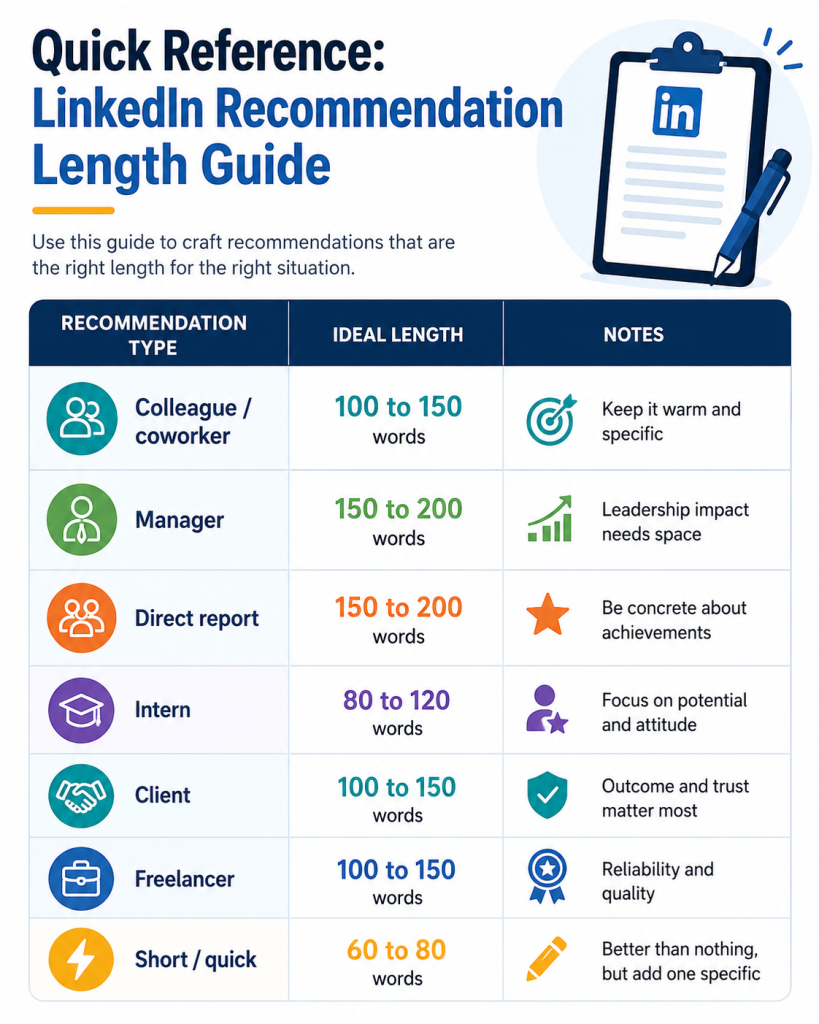
Quick Reference: LinkedIn Recommendation Length Guide
| Recommendation Type | Ideal Length | Notes |
|---|---|---|
| Colleague / coworker | 100 to 150 words | Keep it warm and specific |
| Manager | 150 to 200 words | Leadership impact needs space |
| Direct report | 150 to 200 words | Be concrete about achievements |
| Intern | 80 to 120 words | Focus on potential and attitude |
| Client | 100 to 150 words | Outcome and trust matter most |
| Freelancer | 100 to 150 words | Reliability and quality |
| Short / quick | 60 to 80 words | Better than nothing, but add one specific |
Ready to Build a LinkedIn Profile Worth Recommending?
Great recommendations are one piece of a strong LinkedIn presence. The other piece is content. Consistent, well-designed posts and carousels are what keep your profile active, build your personal brand, and make the people who read your recommendations want to follow you.
Contentdrips helps you create LinkedIn carousels, quote posts, and visual content in minutes. Write your topic, pick a template, apply your brand, and publish directly to LinkedIn — no design skills needed.
Strengthen the rest of your profile with a LinkedIn profile generator , LinkedIn headline generator, and LinkedIn summary generator.
Start creating with Contentdrips for free — No credit card required.
Frequently Asked Questions
How long should a LinkedIn recommendation be? Aim for 100 to 200 words. Long enough to include a specific example, short enough to actually be read in full. Recommendations under 60 words often lack the detail to be convincing.
Can I write my own LinkedIn recommendation? You can write a draft for someone else to review, edit, and post on your behalf. This is completely normal and actually increases the chance of receiving a recommendation, since it removes the blank-page problem for the person you are asking.
How many LinkedIn recommendations should I have? Three to five strong, specific recommendations are more valuable than ten generic ones. Focus on quality. Aim for at least one from a direct manager, one from a colleague, and one from a client or stakeholder.
Can I edit or hide a LinkedIn recommendation I received? Yes. Go to your profile, scroll to the Recommendations section, click the pencil icon, and you can hide individual recommendations without deleting them. You cannot edit the text of a recommendation someone else wrote.
Should I ask for recommendations from everyone I have ever worked with? No. Focus on people who can speak to specific skills or achievements that are relevant to where you want to go next. A recommendation from your most recent direct manager is worth more than five from casual professional acquaintances.