Starting a new job is one of the biggest professional milestones you will experience. And yet, when most people sit down to write a LinkedIn post about it, they draw a complete blank or worse, they churn out the same “I am thrilled to announce” post that floods everyone’s feed every Monday morning.
Here is the thing: a new job post is not just an announcement. It is one of the highest-visibility posts you will ever publish. Your network is paying attention. Former colleagues, potential future employers, clients, collaborators are all watching. How you write this post says a lot about who you are professionally.
This guide will walk you through exactly how to write a LinkedIn new job post that stands out, feels authentic, and actually gets engagement.
Why Most New Job Posts Fall Flat
Before we get into the tips, let’s talk about what goes wrong.
The typical new job post looks like this:
“Excited to announce that I have joined [Company] as [Title]! Looking forward to this new chapter and the amazing journey ahead. Grateful for everyone who supported me. Let’s connect!”
It is not bad. It is just forgettable. It tells your network nothing about you, nothing about the role, and gives them no reason to engage beyond a polite like.
The problem is not the announcement rather it is the absence of a story, a perspective, or anything specific enough to be interesting.
8 Tips for Writing a LinkedIn New Job Post That Gets Noticed
1. Lead with the story, not the announcement
The announcement itself — “I joined X company” — is the least interesting part of the post. What is interesting is the journey that led you there. Did you leave a stable job to take a risk? Did this role find you when you were not even looking? Did you pivot industries entirely?
Open with the moment, not the title. A reader who feels something in the first two lines will read the rest.
2. Be specific about what you are walking into
“Excited for this new chapter” tells your audience nothing. Instead, say exactly what you will be doing, what problem you are there to solve, or what excites you about the specific work ahead. Specificity is what separates a memorable post from a generic one.
For example: “I am joining [Company] to help build their content engine from scratch. No playbook, no team yet, just a blank page and a lot of ambition.”
That is interesting. That makes someone want to follow your journey.
3. Acknowledge the people who got you there but make it specific
Generic gratitude (“grateful for everyone who supported me”) reads as filler. If you want to thank people, name them or describe what they did. “My manager at [Previous Company] pushed me into rooms I had no business being in and that confidence is what got me here.” That is a sentence people will remember.
4. Keep it to one emotion, not three
New job posts often try to be excited, grateful, humbled, and nervous all at once. Pick the one that is most true and own it. Readers connect with clarity of feeling and not a buffet of emotions that cancel each other out.
5. Mention what you are leaving, not just what you are joining
If you spent meaningful time somewhere before this role, acknowledge it. What did you learn? What are you carrying forward? This gives your post depth and shows professional maturity. It also makes the transition feel earned rather than just announced.
6. End with something that invites conversation and not a generic CTA
“Let’s connect!” is the laziest ending on LinkedIn. Instead, close with something that opens a real dialogue. Ask your network a question related to your new role. Share something you are nervous about or excited to learn. Give people a reason to reply.
7. Do not over-explain the company
Your network can Google them. One sentence on what the company does is enough. After that, get back to your own story.
8. Write it the day after you start, not the day you sign the offer
The best new job posts are written from a place of genuine feeling, not anticipation. Wait until you have actually walked in, met the team, and felt something real. That authenticity comes through in the writing.
Fill-in-the-Blank Templates
Use these as starting points and not scripts. Replace every bracket with something specific and true to your experience.
Template 1: The Story-Led Post
After [X years] doing [what you did], I have joined [Company Name] as [Job Title].
The honest version of how I got here: [one sentence about the real journey — a pivot, a risk, a long road].
What I am walking into: [one specific sentence about the actual work or challenge ahead].
I am [one emotion — not three]. Mostly because [specific reason].
To everyone at [Previous Company] — [one specific thing you are taking with you].
If you are working in [relevant field or topic], I would love to hear from you. [Specific question or conversation opener].
Template 2: The Lesson-Forward Post
I spent [X years] learning [specific skill or lesson] at [Previous Company].
Today I am taking that to [New Company] as their new [Job Title].
Here is what I know going in: [2–3 honest things you believe about the work ahead].
Here is what I do not know yet: [1 honest thing you are still figuring out].
If you have experience in [relevant area], I am all ears.
Template 3: The Short and Sharp Post
New role. New company. Same obsession with [the thing you care about most professionally].
Starting as [Job Title] at [Company] this week.
[One sentence on why this specific company, not just any company].
Ask me anything about [relevant topic] — I will be living and breathing it for the foreseeable future.
Mid-Point Check: Save Yourself the Blank Page
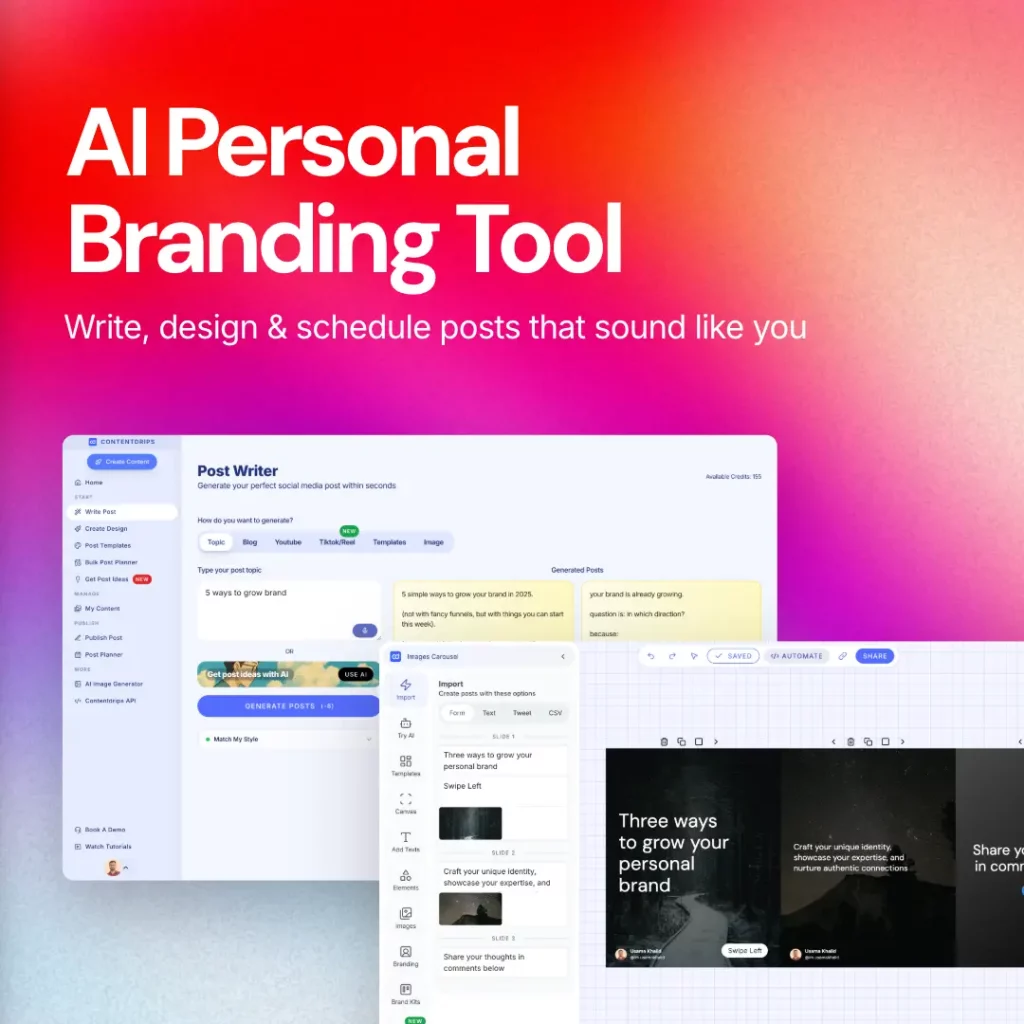
If writing this post still feels harder than it should, that is usually because the words are there but they are just not organised yet. Contentdrips’ AI Post Writer lets you drop in your thoughts in rough form and shapes them into a post that actually sounds like you. It learns your writing style and writes from there.
→ Try the AI Post Writer on Contentdrips
What to Avoid
Avoid the humble brag opener. “I am humbled and honoured to announce…” sets a tone that most readers immediately tune out. Just say what happened.
Avoid tagging everyone. Tagging your new company, your manager, your old company, and three colleagues in one post looks like a reach for visibility. Tag one person if it is genuinely relevant. That is enough.
Avoid the essay. A new job post does not need to be 500 words. If you can say it in 150 words with clarity and specificity, that is better than 400 words of filler.
Avoid posting on your first day. You have nothing real to say yet. Wait until you feel something worth sharing.
The One Thing That Makes All the Difference
Every tip in this post comes down to the same thing: specificity beats enthusiasm every time.
Your network does not need to know you are excited. They need to know who you are, what you are doing, and why it matters to you. Give them that, and your new job post will do more for your personal brand than any amount of polished corporate language ever could.
→ Ready to write your new job post without staring at a blank page? Use Contentdrips’ AI Post Writer — paste your rough thoughts and get a post that sounds like you in seconds.