People are using AI for everything — from brainstorming campaign ideas to drafting entire content calendars. So why not use it as your personal Instagram caption writer? Whether you post once a week or manage content for multiple accounts, this guide will show you exactly how to get captions that actually sound good — with 10 free prompts you can copy and use today.
Imagine you have a beautiful photo or an engaging Reel you want to share. You want to pair it with a caption that stops the scroll, sounds like you, and gets people to engage. That’s where AI comes in. With the right prompt, you can get a well-crafted caption in seconds — one that complements your content instead of sounding robotic.
You can also use AI to generate alt text for your posts, which provides a textual description of your visual content for people who can’t see it.
Let’s look at the prompts.
The Instagram Caption Swipe File: 10 Free Prompts
Don’t forget to customise each prompt before using it. Replace everything in [brackets] with information relevant to your post.
Prompt 1 — The Motivational Quote Post
Write me a caption for an Instagram post.
The picture contains a motivational quote: [paste the quote here].
Keep the tone and style of the caption [simple and professional].
Mention a [thought-provoking] question or CTA related to the [quote] in the image.
My target audience is [professionals] aged [20–50 year olds].
Why it works: Gives the AI the exact quote so the caption builds around it — not around a generic interpretation. The CTA invites followers into a conversation instead of just broadcasting.
Example output:
🔒 Unlock Your Productivity Potential
Your to-do list is the compass that guides your productivity journey. Success is determined by how you structure it. 📋
Are you maximising your daily tasks to reach your goals efficiently? 🎯 Reflect on your planning strategy and share your tips below! 💡
#ProductivityMatters #GoalGetter #EfficiencyBoost #TaskMaster #WorkSmart #SuccessMindset
Prompt 2 — The Relatable Meme or Funny Video
Write me a caption for an Instagram post.
The video contains a meme that is [funny and relatable]: [describe what happens in the meme].
Keep the tone and style of the caption [simple and casual].
Mention a [funny or relatable] question or CTA related to the .
My target audience is [casual users] aged [20–35 year olds].
Why it works: Matching a casual, low-pressure tone to meme content is something AI often gets wrong when given no direction. This prompt locks in the right register before it writes a single word.
Example output:
Swipe left if you’re tired of playing ‘Sales Pitch or Legit Connection?’ on LinkedIn 😂🙋 Can you relate? Drop a comment with your most memorable pitch encounter below!
#LinkedInLife #SalesPitchSurprise
Prompt 3 — The Personal Story or Behind-the-Scenes Post
Write me a caption for an Instagram post.
The photo shows [describe what's in the image — setting, people, mood].
I want to share a short personal story about [topic or moment].
Keep the tone [warm, honest, and personal] — like I'm talking to a friend.
End with a question that gets people to share their own experience.
My target audience is [audience description] aged [age range].
Why it works: Storytelling captions outperform pure promotional ones because they trigger emotional responses. This prompt gives the AI enough context to write something that feels lived-in rather than manufactured.
Prompt 4 — The Product or Service Showcase
Write me a caption for an Instagram post showcasing [product or service name].
The image shows [describe the visual].
Highlight these key benefits: [benefit 1], [benefit 2], [benefit 3].
Keep the tone [confident but not pushy].
Include a soft CTA — something like "link in bio" or "DM us to learn more."
No more than 3 hashtags.
My target audience is [audience].
Why it works: Most AI-generated product captions default to salesy language. This prompt explicitly tells it not to — which changes the output significantly. Limiting hashtags keeps it looking polished.
Prompt 5 — The Educational Carousel
Write me a caption for an Instagram carousel post.
The carousel teaches [topic] in [number] slides.
Start the caption with a hook that makes someone want to swipe.
Keep the body concise — 2 to 3 sentences max.
End with a save prompt and one question.
My target audience is [audience] aged [age range].
Why it works: Carousel posts need a different caption structure than single images — the hook needs to justify the swipe. This prompt bakes that mechanic in from the start.
Prompt 6 — The Announcement Post
Write me a caption for an Instagram announcement post.
I'm announcing [what you're launching or sharing].
The tone should feel [exciting but grounded — not hype-y].
Include context: [one sentence about what this means for your audience].
End with a CTA: [tell them what to do next — comment, visit link in bio, save, etc.].
My audience: [description].
Why it works: Announcements often come out either too flat or too over-the-top. Explicitly flagging “exciting but grounded” steers AI away from exclamation-mark overload.
Prompt 7 — The Inspirational Reel
Write me a caption for an Instagram Reel.
The Reel shows [describe what happens in the video].
The overall message I want to leave people with is: [one sentence].
Tone: [inspiring, honest — not preachy].
Keep it short — under 100 words.
End with a question.
Hashtags: 5–8, relevant to [niche].
Why it works: Reels captions live mostly below the fold — they need to be concise enough that readers actually finish them. This prompt enforces a word limit so you don’t get a caption essay.
Prompt 8 — The Community or Engagement Post
Write me a caption for an Instagram post designed to spark conversation.
The image shows [describe the visual].
The topic I want people to talk about is: [topic].
Don't give a strong opinion — instead, ask a question that gets people to share theirs.
Tone: [curious, casual, inviting].
My audience: [description].
Why it works: Community-building posts should hold back the brand’s opinion and make space for the audience. This prompt explicitly tells the AI to do that — otherwise it’ll write an opinion piece by default.
Prompt 9 — The Testimonial or Results Post
Write me a caption for an Instagram post sharing a result or testimonial.
Here's the core outcome: [describe the result in one or two sentences].
Don't make it sound like an ad. Make it sound like a real story.
Tone: [genuine, understated, credible].
End with a soft question or CTA.
Keep hashtags to a minimum — 2 or 3 max.
Why it works: Social proof is powerful, but AI tends to make testimonial captions sound like advertising copy. “Don’t make it sound like an ad” is one of the most useful single instructions you can add to any prompt.
Prompt 10 — The Seasonal or Trending Moment
Write me a caption for an Instagram post about [seasonal event / trending topic].
Connect it back to my niche, which is [your niche/industry].
Keep it timely and relevant — don't force the connection if it doesn't feel natural.
Tone: [light, aware, conversational].
My audience: [description].
Add 4–6 relevant hashtags.
Why it works: Jumping on trends works when the connection to your brand feels genuine. Telling the AI explicitly not to force it actually improves quality — it tends to find the more elegant angle instead.
Getting Better Results From Any Prompt
Once you have a first draft, you can push it further with simple follow-up instructions:
- “Make it more personal and less salesy” — pulls the tone away from corporate language
- “Make it shorter” — trims to essentials without losing the message
- “Make it longer” — useful when you want more storytelling or context
- “Rewrite this but start with a stronger hook” — fixes weak openers
- “Make it sound less like AI wrote it” — often the single most useful instruction
The AI remembers the conversation context, so you don’t need to repeat the whole prompt — just give the adjustment instruction.
Generating Alt Text for Your Posts
Alt text makes your Instagram posts accessible to people who can’t see your images. Every AI tool can generate it for you in under 10 seconds.
The easiest method: after generating your caption in the same chat, ask:
“Can you give me the alt text for this post?”
The AI will use the context from your caption prompt to write an accurate description. If you’re starting a fresh conversation, use this:
Write me alt text for an Instagram post.
The image shows: [describe what's in the image in specific detail].
Keep it under 125 characters.
Describe what's visible — not what the image means.
Example output:
“Flat lay of a notebook, coffee cup, and laptop on a wooden desk. Natural morning light. Text overlay reads ‘Plan your week, own your results.'”
This one is slightly more involved because you need to describe the content to the AI — but the output is accurate, natural-sounding alt text every time.
How to Add Alt Text on Instagram
- When creating a post, tap Advanced settings before sharing
- Scroll down to Accessibility
- Tap Write alt text
- Paste the AI-generated alt text
- Tap Save, then share your post
Which AI Tool Should You Use?
All of the prompts above work with any major AI writing tool. Here’s a plain-language breakdown of how they compare for Instagram caption writing specifically.
| ChatGPT | Claude | Gemini | Contentdrips | |
|---|---|---|---|---|
| Follows structured prompts | ✅ Best | ✅ Good | 〰 Decent | ✅ Built-in |
| Matches your writing voice | 〰 Good | ✅ Best | 〰 Decent | ✅ Automatic |
| Image-to-caption | ✅ Good | ✅ Good | ✅ Best | ✅ Good |
| Alt text generation | ✅ Good | ✅ Good | ✅ Good | ✅ Good |
| Built for social media | ❌ General | ❌ General | ❌ General | ✅ Yes |
| No prompt-writing needed | ❌ | ❌ | ❌ | ✅ Yes |
| Learns from your past content | ❌ | ❌ | ❌ | ✅ Match My Style |
| Free tier available | ✅ | ✅ | ✅ | ✅ |
ChatGPT is great if you enjoy building and refining prompts — it follows structured instructions precisely and is excellent for bulk generation.
Claude stands out when you need the caption to sound like you. Give it a few examples of your past writing and it will match your tone better than any other general-purpose tool.
Gemini is strongest when you upload an image directly and want it to write a caption around what’s actually in the photo.
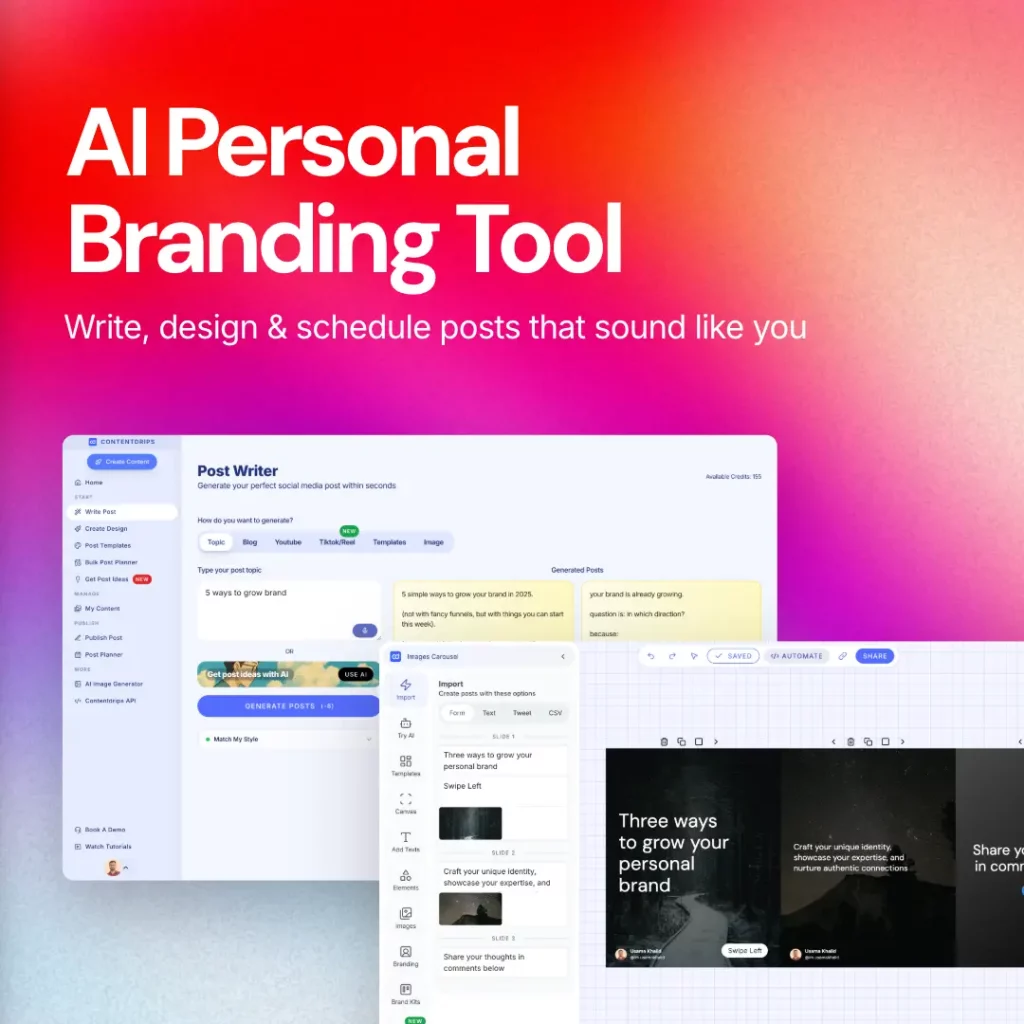
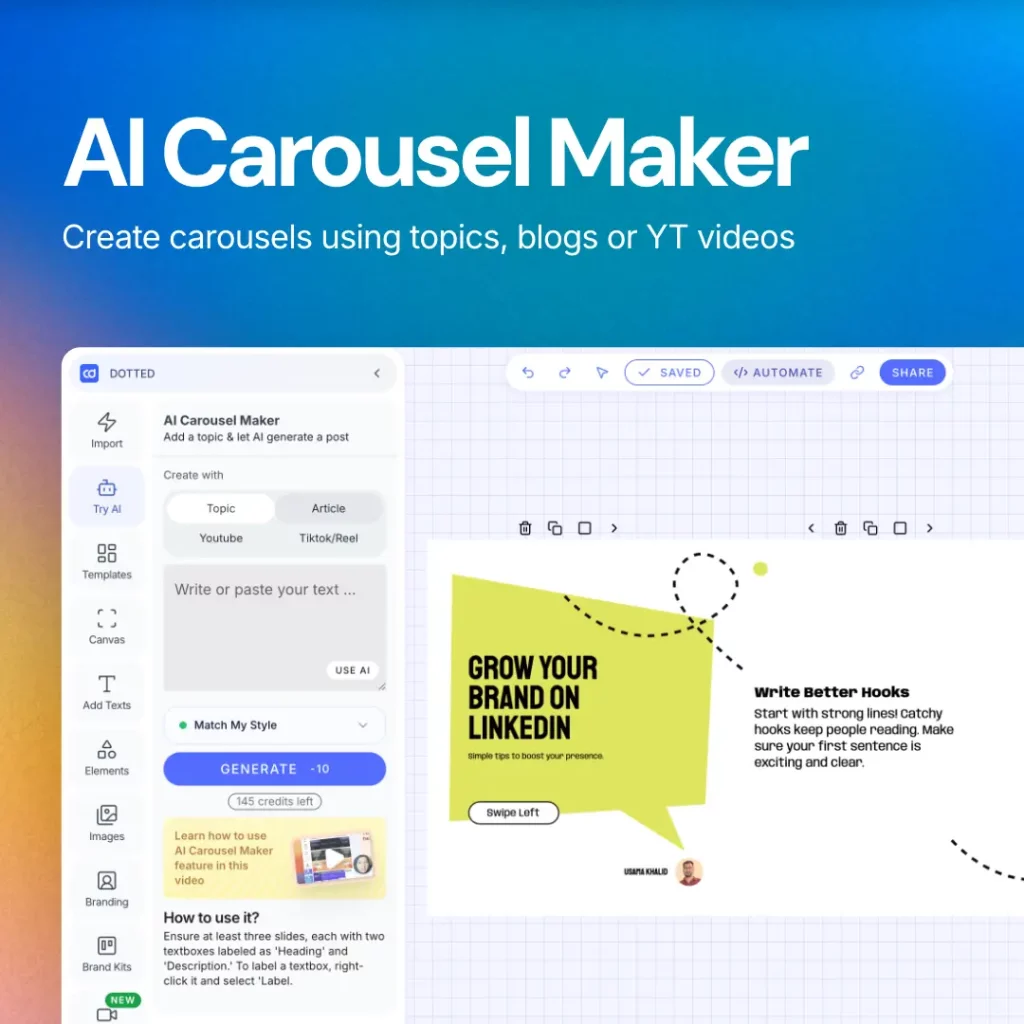
Contentdrips is the only one built specifically for social media content. The Post Writer generates captions for Instagram, LinkedIn, TikTok, Facebook, and Twitter — from a topic, YouTube video, blog article, image, or your own ideas. The Match My Style feature learns from your past content automatically, so every output already sounds like you without needing to paste examples. If you want results without the prompt-engineering overhead, it’s the obvious choice.
Go ahead, test it out, and make AI your personal caption writer for Instagram — whether you’re just starting out with prompts or ready to skip them entirely.
Share this post: Facebook · Twitter · LinkedIn
Frequently Asked Questions
Can AI write Instagram captions for me?
Yes — AI tools like ChatGPT, Claude, and Gemini can write Instagram captions from a simple text prompt. You describe your post, your audience, and the tone you want, and the AI generates a full caption including a hook, body, CTA, and hashtags. The quality improves significantly when you give the AI specific context rather than a vague brief. If you’d rather skip the prompting entirely, Contentdrips Post Writer is built specifically for social media and generates Instagram captions in one click from a topic, image, video, or blog post.
What is the best AI tool for writing Instagram captions?
There’s no single best tool — it depends on what you need. ChatGPT is excellent for following structured prompts and generating captions in bulk. Claude is the strongest at matching a specific writing voice and brand tone. Gemini is best when you upload an image and want a caption written around what’s in the photo. Contentdrips is the only tool purpose-built for social media — it handles Instagram natively, includes ready-made templates, and has a Match My Style feature that learns from your past posts so captions sound like you without any extra prompting.
How do I write a good Instagram caption with ChatGPT?
The key is to be specific in your prompt. Tell ChatGPT what’s in the image or video, what tone you want (casual, professional, humorous, inspirational), who your target audience is, and what action you want people to take. A vague prompt like “write me an Instagram caption” produces generic output. A detailed prompt that includes the visual, the message, the audience, and a CTA produces captions that are actually usable. Use the swipe file prompts above as your starting templates and customise from there.
Are AI-generated Instagram captions detectable?
Increasingly, yes — especially when they’re not edited. Common tells include overuse of phrases like “dive in,” “unleash your potential,” and “in today’s fast-paced world,” excessive exclamation marks, and a structure that feels templated rather than personal. The fix is simple: use AI to get a strong first draft, then read it out loud and edit anything that doesn’t sound like how you actually talk. One or two personal details or a specific reference to your niche goes a long way. Tools like Contentdrips Post Writer reduce this problem because the Match My Style feature trains on your own content — so the AI is already writing in your voice rather than a generic one.
How do I make AI captions sound more like me?
The most effective method is to give the AI examples of your past writing. Paste two or three captions you’ve written before and say “match this style.” Claude handles this particularly well. For an automated version of the same thing, Contentdrips Post Writer has a built-in Match My Style feature that learns from your existing content and applies your voice to every new caption without you needing to paste examples each time.
Can I use AI to write Instagram captions for free?
Yes. ChatGPT, Claude, and Gemini all have free tiers that are capable enough for caption writing. The free versions do have usage limits and may not include the latest features, but they’re more than sufficient for generating and refining individual captions. Contentdrips also offers a free tier to get started.
How long should an Instagram caption be?
It depends on your content type and audience, but as a general guide: single images and Reels work well with shorter captions (under 150 words) that get to the point quickly, while carousel posts and educational content can support longer captions (150–300 words) because followers are already in a reading mindset. Instagram truncates captions after three lines in the feed, so your first sentence — the hook — is the most important part regardless of total length. When prompting AI, you can specify a word count or ask it to “make it shorter” or “make it longer” as a follow-up instruction.
Do hashtags still matter on Instagram in 2026?
Yes, but the strategy has shifted. Instagram’s own advice has moved toward using fewer, more specific hashtags (3–8) rather than loading up with 30 broad ones. Niche hashtags that closely match your content and audience tend to outperform generic high-volume ones. When using AI to generate captions, it’s worth asking it to keep hashtags focused and relevant rather than maxing out the count. You can specify the number directly in your prompt: “add 5 relevant hashtags” works better than leaving it open-ended.
Can AI generate alt text for Instagram posts?
Yes, and it does it well. After generating your caption in the same chat, you can simply ask “Can you give me the alt text for this post?” and the AI will write a descriptive, accessible text based on the context you already provided. If you’re starting fresh, describe the image in detail and ask for alt text under 125 characters. Adding alt text to your posts takes about 10 seconds (Advanced settings → Accessibility → Write alt text before posting) and makes your content accessible to visually impaired followers.
What makes a good Instagram caption prompt for AI?
A good prompt includes five things: what’s in the image or video, the tone you want, your target audience, the action you want people to take (the CTA), and any constraints like length or hashtag count. The more specific you are, the less editing the output needs. Generic prompts produce generic captions. If you find yourself editing heavily every time, the fix is usually to add more context to the prompt — not to keep regenerating and hoping for something better.
Is there an AI tool that writes Instagram captions automatically without prompting?
Yes — Contentdrips Post Writer is designed to do exactly this. Rather than requiring you to craft a detailed prompt from scratch, it takes an input (a topic, a YouTube video link, a blog article, an image, or an idea) and generates a ready-to-post Instagram caption for you. The Match My Style feature means it already writes in your voice without needing examples. It’s the closest thing to a fully automated Instagram caption writer available, and it’s built specifically for social media rather than being a general-purpose AI tool adapted for it.