If you manage Instagram accounts for a living, you have probably had this exact argument with a client or a boss: “Why aren’t we posting more Reels? Everyone says video is what works now.”
Meanwhile, your carousels are the posts quietly pulling in saves, comments, and follower growth, while last week’s Reel got views and nothing else.
This is not a contradiction. It is two different tools doing two different jobs, and in 2026, Instagram’s own ranking systems treat them differently on purpose. Once you understand what each format is actually built to do, the “which one should I post” question stops being a guess and turns into a decision you can defend with data.
This guide breaks down what the most recent platform data says, what Instagram has confirmed about how its algorithm scores each format, and how to build a content mix that uses both the way they were designed to be used.
The 2026 Verdict at a Glance
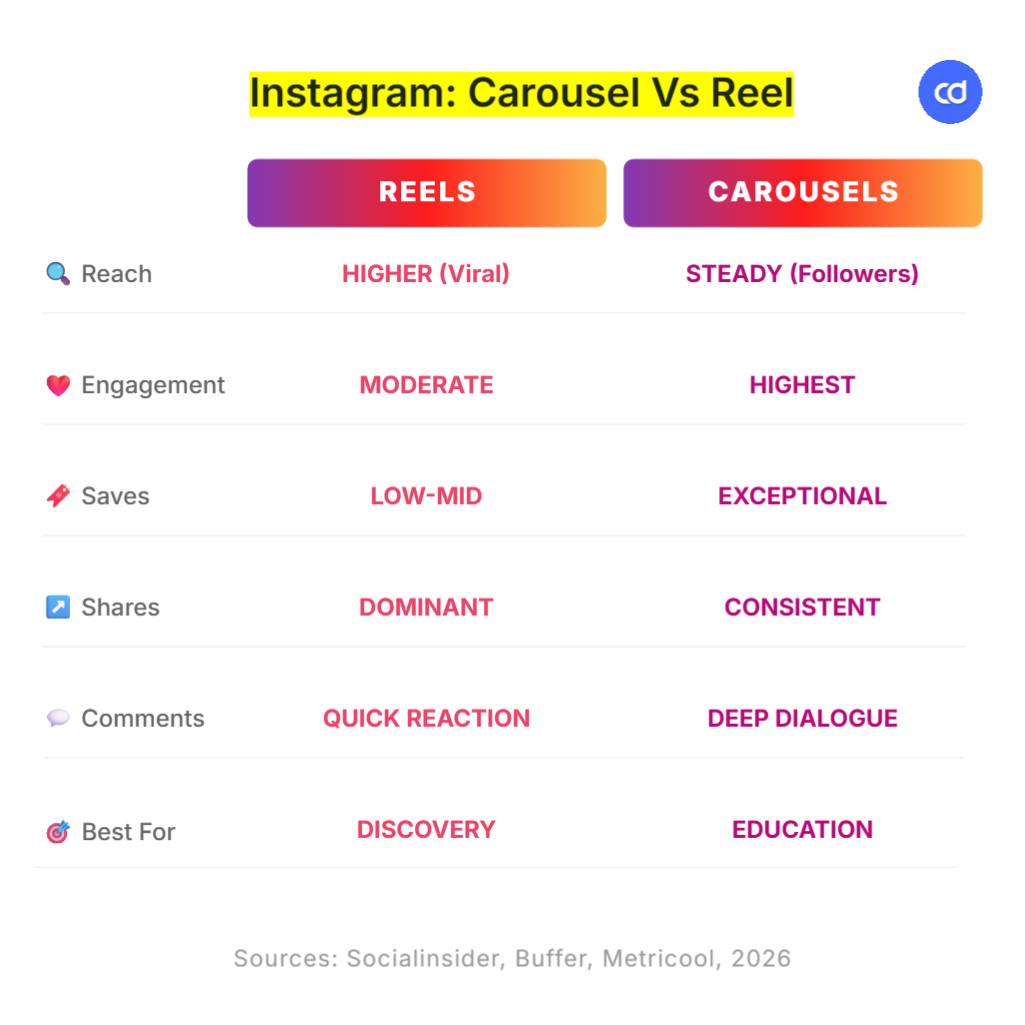
Before the deep dive, here is the short version. Bookmark this table.
| Metric | Reels | Carousels |
|---|---|---|
| Reach (especially non-followers) | Higher | Lower |
| Engagement rate by reach | Lower | Higher |
| Saves | Moderate | Highest |
| Shares / sends | Highest | Moderate |
| Comments | Highest | Moderate-high |
| Best for | Discovery, brand awareness, riding trends | Education, authority, saves, nurturing existing followers |
| Production time | Higher (scripting, filming, editing) | Lower, especially with templates |
| Shelf life | 24-72 hours, then decays fast | Days to weeks, gets a second chance via the re-serve mechanic |
| Wins for accounts under 1,000 followers | Yes | No |
| Wins for accounts over 1 million followers | No | Yes |
If you only remember one line from this whole guide, remember this: Reels are built to win reach. Carousels are built to win engagement. Neither is “better.” They are solving different problems.
What the Data Actually Says
It is easy to find a hot take on this topic. It is harder to find numbers that hold up. Here is what the most current Instagram-specific research shows.
Engagement rate: carousels still lead
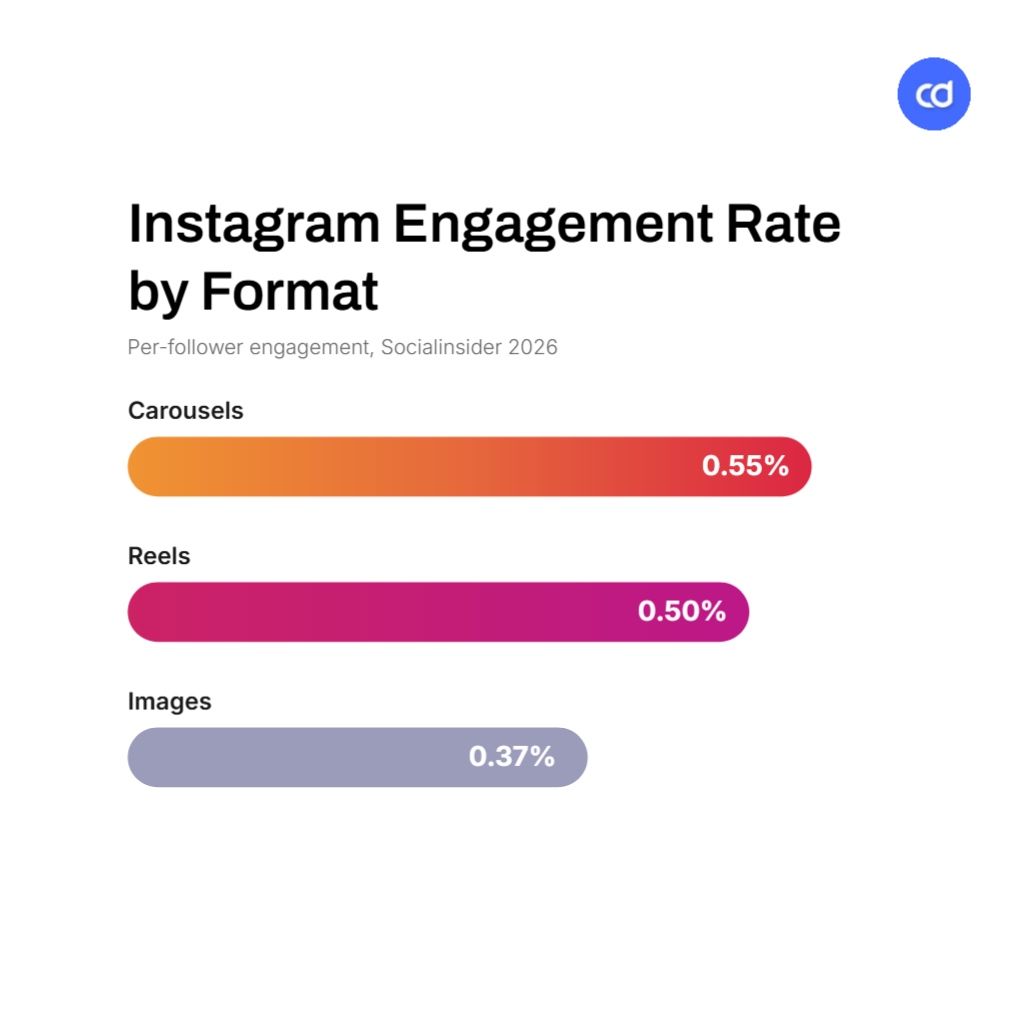
Socialinsider’s 2026 Instagram benchmark report, based on a year of data through Q1 2026, puts carousels at the top of the engagement leaderboard with a 0.55 percent engagement rate, ahead of Reels at roughly 0.50 to 0.52 percent and single images at around 0.35 to 0.37 percent. That ranking has held steady since 2023, which tells you this is not a fluke quarter, it is a structural pattern.
Buffer’s analysis of more than 52 million posts measures things slightly differently (engagement by reach rather than by follower count) and finds an even bigger gap: carousels earn a 6.90 percent engagement rate by reach compared to 3.31 percent for Reels. Buffer’s own framing is worth repeating directly: Instagram is functioning like two different platforms depending on which format you post, one optimized for reach and one optimized for engagement.
Reach: Reels still pull ahead
None of this means Reels are pointless. The same Buffer dataset shows Reels getting roughly 36 percent more reach than carousels. If your goal is getting in front of people who do not follow you yet, Reels are still doing more of that heavy lifting.
Metricool’s 2026 Instagram study, drawn from 24.3 million posts and published in June 2026, backs this up from another angle. Reels generated more than four times the interactions of single-image posts, and average watch time more than doubled year over year to 8.5 seconds. At the same time, carousels generated nine times more saves than single images and outperformed single images across nearly every metric Metricool tracked. Two formats, two different jobs, both confirmed in the same dataset.
Saves, shares, and comments split cleanly by format
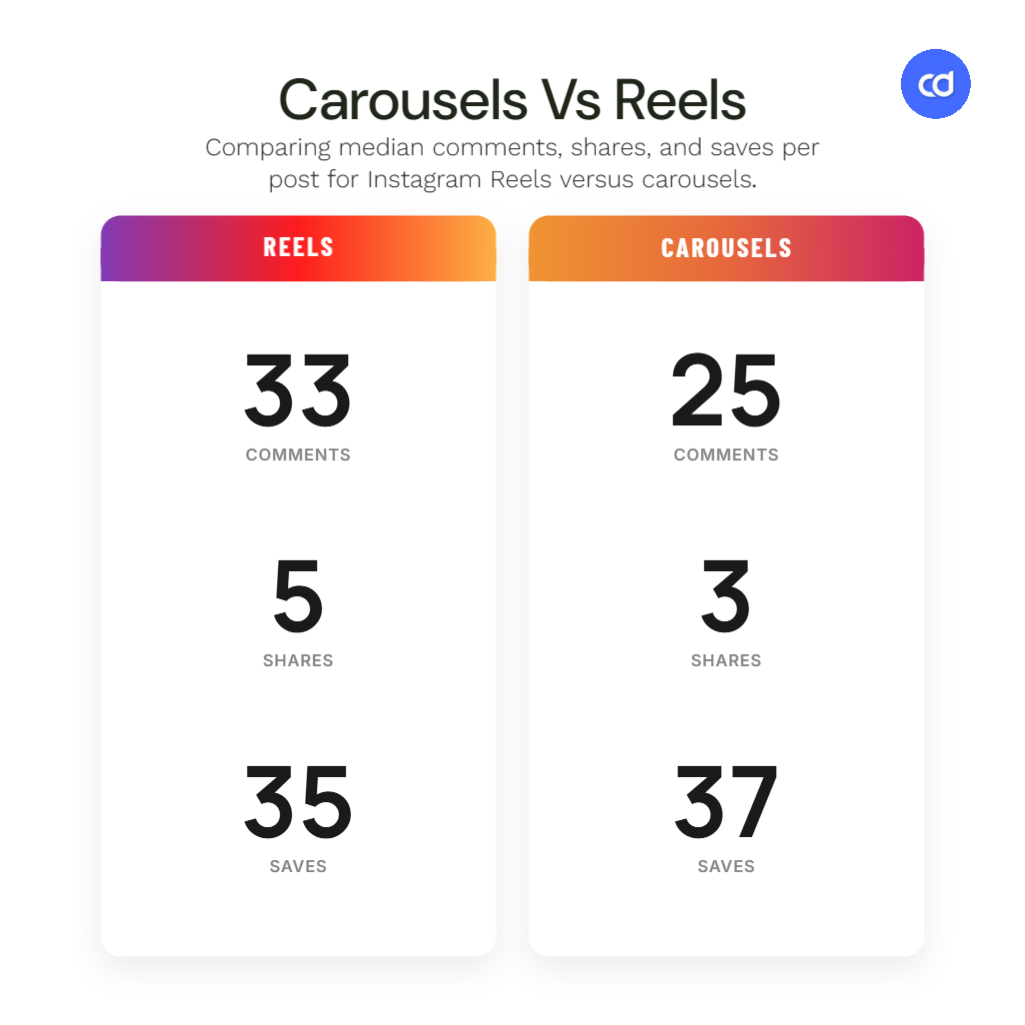
Socialinsider’s engagement report, covering 15 million posts from October 2025 through March 2026, breaks engagement down by type, and the pattern is consistent enough to plan around:
- Reels: roughly 33 comments and 5 shares per post (median), versus 35 saves
- Carousels: roughly 25 comments and 3 shares per post (median), versus 37 saves
- Images: roughly 20 comments, 1 share, and only 10 saves
Reels drive comments and shares. Carousels drive saves. If your content goal is “get people to act on this later” rather than “get people to react right now,” that distinction should shape your format choice more than almost anything else in this guide.
Account size changes the math
Here is the part most “Reels vs carousels” content skips entirely: the format that wins depends heavily on how big your account already is.
A joint study from Metricool and HypeAuditor, analyzing 700 million posts from January through June 2025, found that small accounts under 1,000 followers see Reels significantly outperform other formats for reach, with a median of 134 views versus 56 for carousels and 23 for images. But the picture flips hard once accounts cross roughly a million followers. At that scale, brand accounts see a median carousel reach of 217,668 compared to 110,500 for Reels, and creator accounts see carousels reaching roughly 219,000 with 15,080 likes versus Reels at 6,400 likes.
The practical takeaway: if you are managing a newer or smaller account, lean on Reels to build reach first. Once an account has an established audience, carousels become the format that compounds.
The same research also flagged something worth sitting with: 93.5 percent of accounts post once a week or less, and that posting cadence correlates with roughly 2 percent average yearly follower loss. Consistency, in either format, is doing more work than people give it credit for.
How the 2026 Algorithm Actually Treats Each Format
Instagram does not run one algorithm. It runs several ranking systems, one for each surface (Feed, Reels, Stories, Explore), and each one weighs signals differently. Understanding what those systems are built to reward explains most of the data above.
The three signals Mosseri confirmed
Adam Mosseri has been unusually direct about this. He has confirmed that across surfaces, the signals that matter most are watch time, likes per reach, and sends per reach, meaning how often a post gets shared via DM. For reaching people who do not already follow you, sends matter more than likes. For your existing audience, likes carry a bit more weight. Watch time sits at the top for both.
This is not a minor detail buried in a developer blog. CreatorFlow’s breakdown of the 2026 algorithm changes and Metricool both note that DM shares carry roughly three to five times more algorithmic weight than a like, and Metricool has reported that 694,000 Reels are sent via DM every single minute across the platform. That is an enormous distribution lever that has nothing to do with likes or comments.
The carousel “re-serve” mechanic
Here is a detail that does not get talked about enough. If a user scrolls past a carousel without engaging, Instagram will sometimes re-show it to them later, often with a different slide (commonly slide two) used as the new cover. No other format gets this second chance at a first impression. It is part of why carousels with a strong second slide, not just a strong first slide, tend to hold up better over time.
What changed going into 2026
On December 31, 2025, Mosseri posted a lengthy year-end memo on Instagram (a 20-slide carousel, fittingly) that set the tone for 2026 priorities. Om Malik’s write-up of the memo captured the core thesis: authenticity is becoming easy to fake at scale, which means raw, clearly human content is becoming more valuable, not less. One line from the memo that has been widely quoted: the bar is shifting from “can you create” to “can you make something that only you could create.”
This connects directly to a separate originality crackdown documented by Net Influencer in February 2026. Original content is earning 40 to 60 percent more distribution than reposted content, and accounts posting ten or more reposts within 30 days are being excluded from recommendations entirely. Aggregator-style accounts saw reach drop by 60 to 80 percent, while accounts posting original work saw reach increase by 40 to 60 percent over the same window. Mosseri reinforced this again in April 2026, telling PetaPixel that if most of what an account posts belongs to someone else, that account is no longer going to be recommendable.
The practical implication for social media managers: whichever format you choose, originality is no longer a nice-to-have. It is becoming a distribution requirement.
When to Use Which
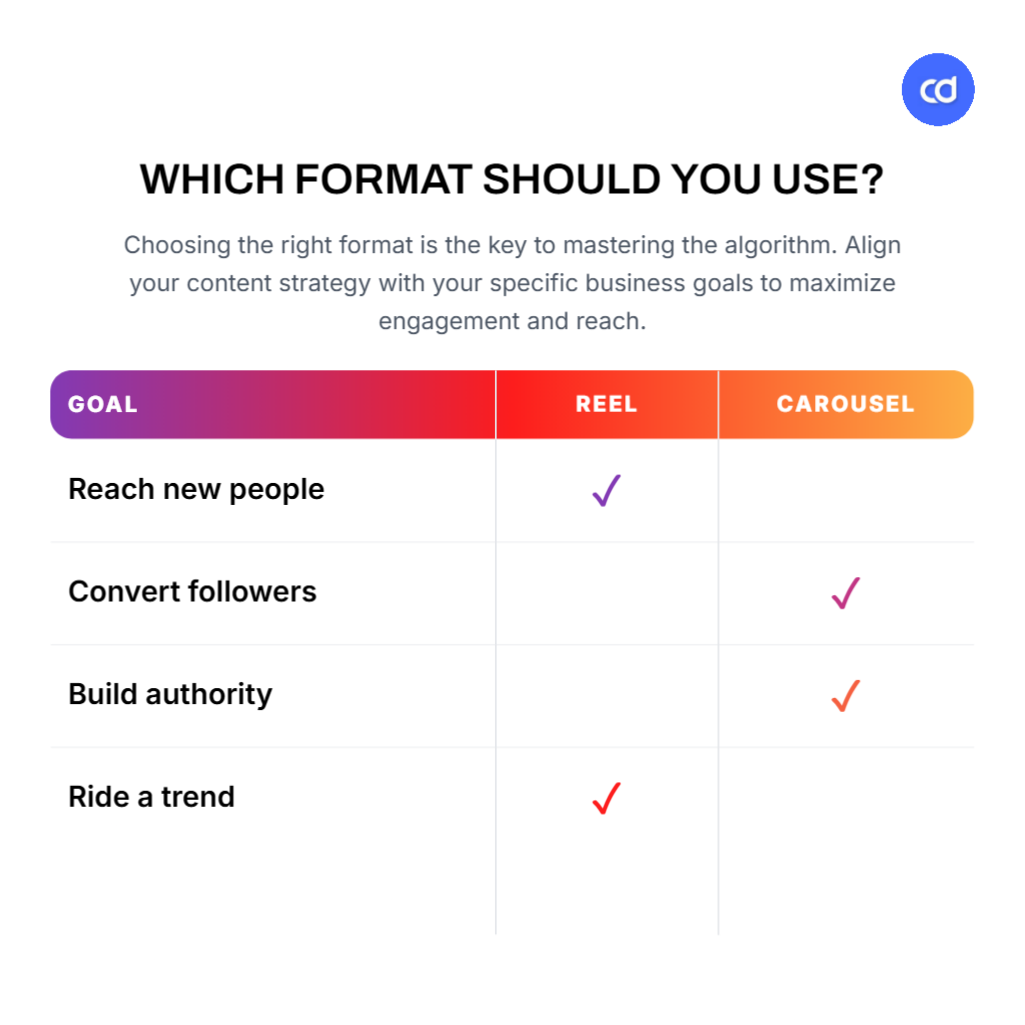
Strip away the algorithm talk and the decision usually comes down to what outcome you are trying to produce.
Reaching people who don’t already follow you. Use Reels. This is what they are built for, and the data backs it up consistently across every study cited here.
Turning existing followers into customers, clients, or community members. Use carousels. They drive saves, hold attention longer per impression, and benefit from the re-serve mechanic that keeps useful content circulating.
Building topical authority, the kind of account people think of as “the” resource on a subject. Use carousels. Saves are a “I will need this later” signal, and that signal is exactly what tells the algorithm your content has lasting value.
Riding a trend, audio, or cultural moment in real time. Use Reels. Speed and relevance matter more than depth here, and Reels are the format built for that kind of immediacy.
What this looks like in practice
Nicole Langdon, who manages social for The Candid Cooks, ran a five-part Reel series that reached nearly 39,000 users. Strong number. But a single carousel from the same account earned a higher engagement rate (6.5 percent versus 3 percent) and more likes (194 versus the top Reel’s 121), despite reaching far fewer people. Her own framing of the tradeoff is the cleanest summary you will find anywhere: if she wants higher reach, she uses a Reel. If she wants higher engagement, she uses a carousel.
That said, format winners are not universal. The same source documents iHeartRaves and INTO THE AM, two festival fashion e-commerce brands, where Reels outperformed static content on engagement between Q1 and Q3 2025, averaging 5.19 percent engagement versus 2.4 percent for static posts. Niche and content type matter. A fashion brand selling an aesthetic and a feeling is going to get more out of motion and sound than a carousel ever could. Test within your own niche before assuming either case study applies to you.
Best Practices Cheat Sheet for 2026
Carousels
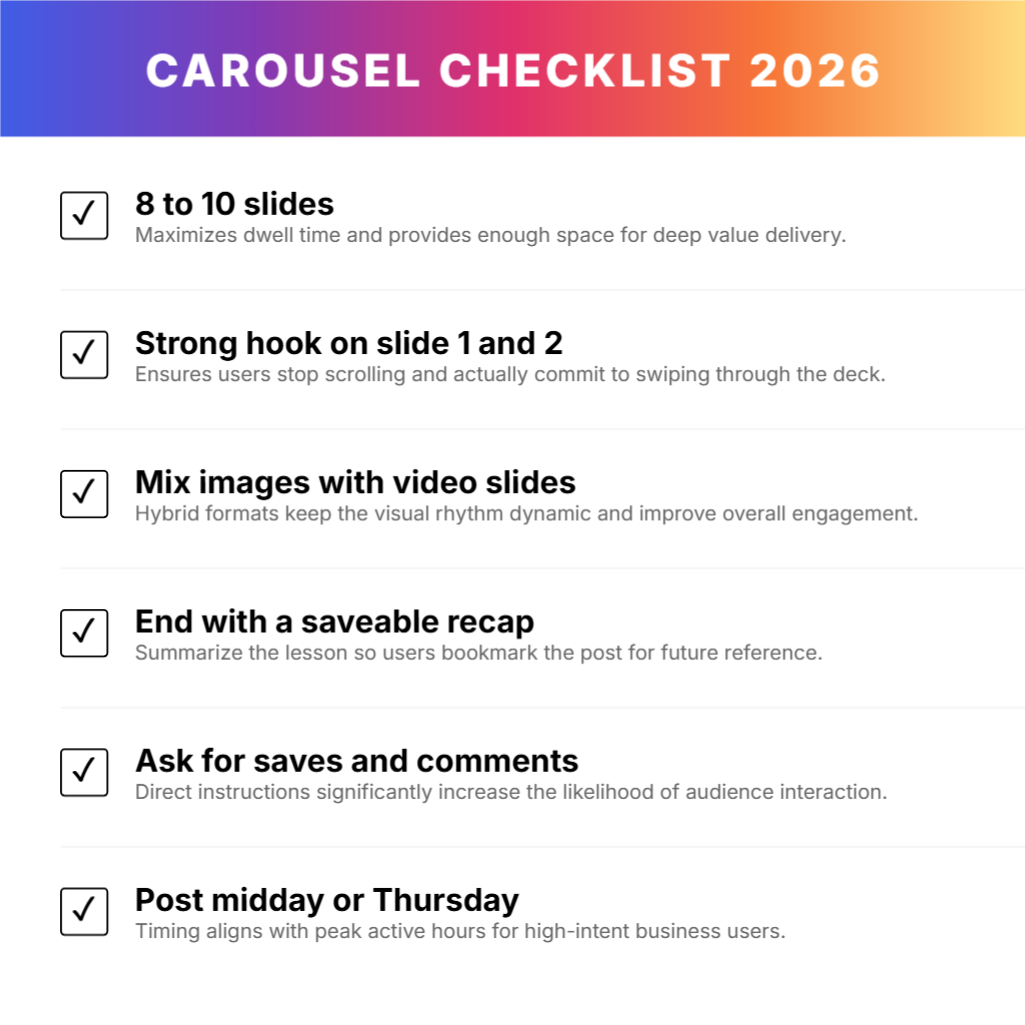
- Slide count: Eight to ten slides is the current sweet spot. Instagram allows up to 20, but data shows engagement climbing as you use closer to the full range, while anything under five slides tends to underperform because it has not delivered enough value to earn a save.
- Slide one is the hook, slide two is the backup hook. Because of the re-serve mechanic, your second slide needs to work almost as hard as your first.
- Mix media types. Carousels combining static images with one or two short video slides are outperforming image-only carousels.
- End with a saveable recap or a clear next step. The last slide is where most of your saves and shares get triggered.
- Caption matters more than people assume. Captions that explicitly ask for comments have been shown to increase comment volume substantially, and captions asking people to save the post for later increase save rates in a similar way.
- Post around midday or Thursday mornings. Carousels reward attention windows where people are more likely to pause and swipe rather than scroll past.
Reels
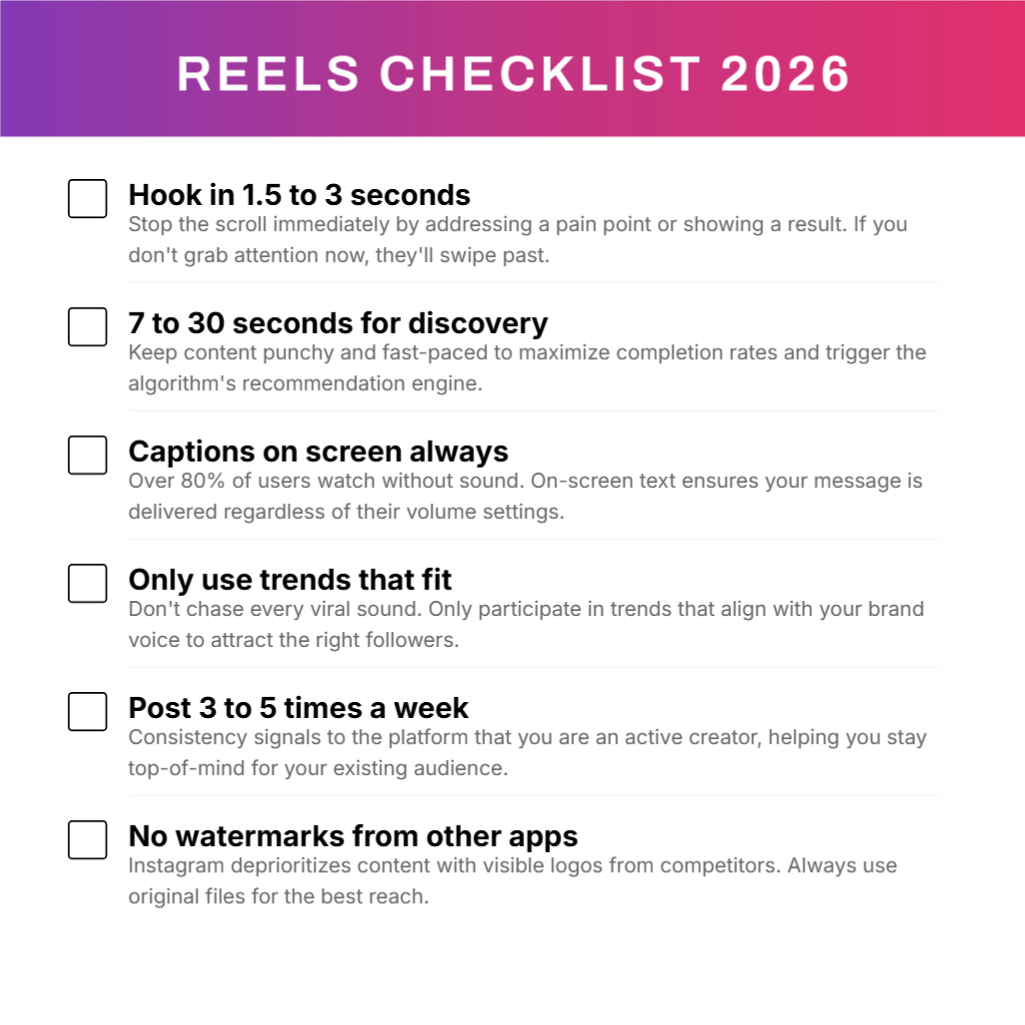
- Hook in the first 1.5 to 3 seconds. Most viewers decide whether to keep watching almost immediately.
- 7 to 30 seconds for discovery content, 30 to 90 seconds for anything educational or conversion-focused. Completion rate and rewatches matter more than raw length.
- Captions on screen. Most people watch with sound off. If writing captions from scratch slows you down, a tool like the Instagram Reels caption generator can draft them for you straight from your video.
- Use trending audio only when it actually fits the content. Forced trend-chasing reads as exactly that.
- Post three to five times a week. Consistency beats volume here, and weekday evenings, particularly Wednesday and Thursday between 6 and 9 PM, tend to perform best.
- Avoid reposting content with another platform’s watermark. Instagram downranks it, and as of the 2026 originality push, this matters more than ever.
- Don’t let a good Reel die on one platform. If a Reel performs well, it is worth turning into a LinkedIn post rather than starting from scratch for a second audience. Tools built for this, like a Reels to LinkedIn post generator, can pull the value out of the video and rebuild it as text in a few minutes.
The Real Bottleneck Nobody Talks About
Here is the part that the data does not solve for you. Knowing that carousels drive saves and Reels drive reach is useful information. It does not make either one faster to produce.
A Reel requires scripting, filming, editing, and captioning before it ever gets posted. A carousel requires writing copy for every slide, designing a layout that holds together visually across eight or ten frames, and making sure it actually looks like it belongs to your brand and not a random template you found at 11 PM. Agencies managing multiple client accounts report spending 20 to 30 minutes per visual when building carousels manually in a general-purpose design tool, and that is before you account for the writing.
This is the actual constraint most social media managers are working against. It is rarely “I don’t know which format to use.” It is “I know exactly which format to use, I just don’t have three hours to make it today.”
Where Contentdrips Fits
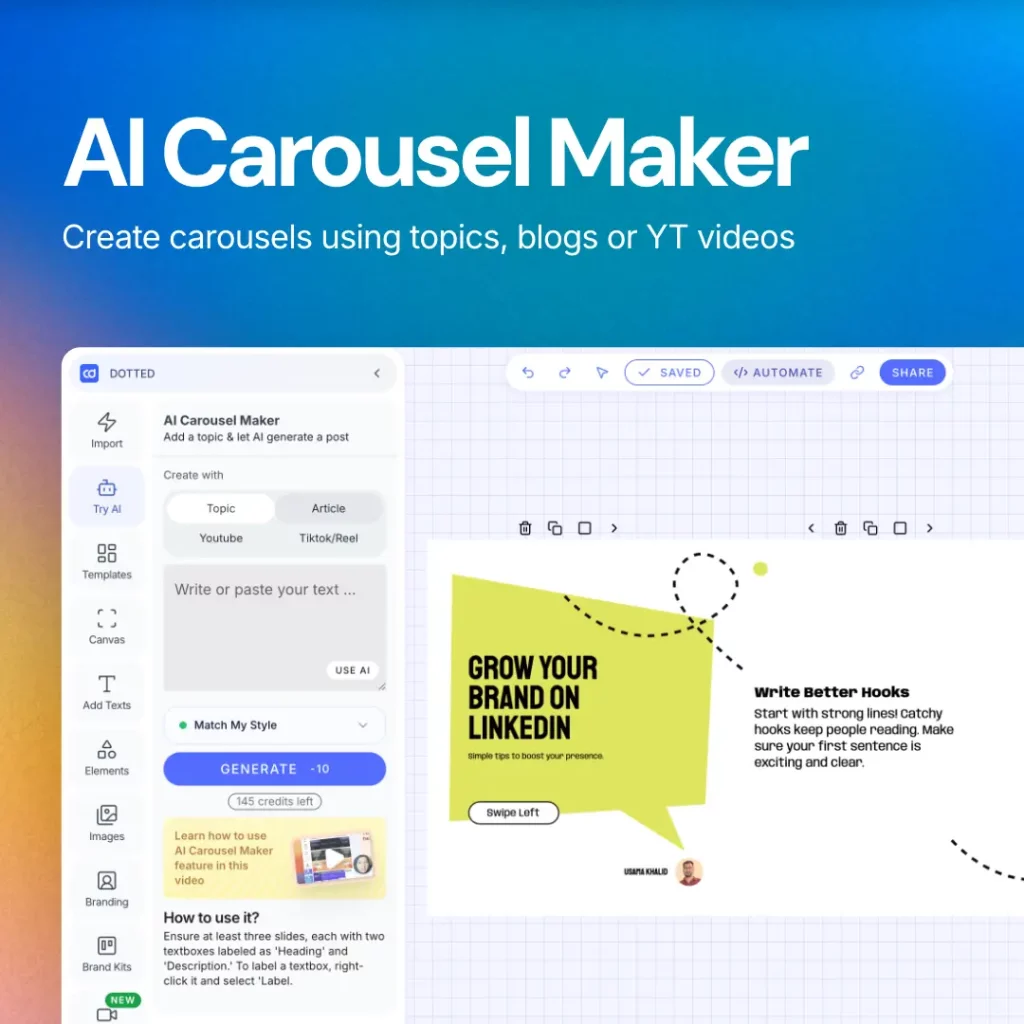
This is the part where, full disclosure, we talk about our own tool. We built Contentdrips specifically to solve the production half of this problem, the part where good strategy runs into a blank canvas and a deadline. Worth saying upfront: Contentdrips is purpose-built for carousels, graphics, and text posts, not Reels or video editing. If your content mix needs both formats, which based on everything above, it probably does, you will likely pair this with a separate tool for filming and editing your Reels. We are the carousel half of that stack, and we have tried to make that half genuinely fast.
Already have a Reel that performed well? Don’t let it stop at one post. This is the part that ties the whole guide together. The data above makes a clear case for running both formats, but most managers don’t have time to build a second piece of content from scratch every time the first one works. Paste an Instagram Reel link into Contentdrips and it pulls the content out and rebuilds it as a text post or a carousel automatically, no rewriting, no re-shooting. One good idea, captured once on video, ends up working as a Reel for reach, a carousel for saves, and a text post for LinkedIn, instead of living and dying as a single piece of content.
For everything else, here are three more ways to put it to work, depending on how much of a head start you want.
Describe what you need and let AI build the first draft. The AI Design Agent takes a plain-language description, something like “five-slide carousel on Instagram algorithm changes, clean minimal style,” and generates a complete, editable carousel from it. You are not starting from a blank canvas, you are starting from a draft you can refine.
Start from a template built around what actually earns saves. The slide-count and hook-slide guidance covered earlier in this guide is baked into the Instagram carousel template library, so you are not guessing at structure, you are filling in a layout that already matches what the data says performs.
Or skip straight to a finished structure and make it yours. If you would rather see one good example than browse a library, this template opens directly in the editor, ready to swap in your own copy, colors, and brand kit.
Whichever entry point you use, the brand kit carries through automatically, so fonts, colors, and logo placement stay consistent without you re-styling every single slide by hand.
Quick Recap
- Carousels win on engagement rate and saves. Reels win on reach, especially to non-followers.
- Instagram’s algorithm rewards watch time and DM shares most heavily for Reels, and saves most heavily for carousels, which is exactly why each format performs the way it does.
- Carousels get a second chance at impressions through the re-serve mechanic. Reels do not.
- Smaller accounts should lean on Reels for reach. Larger, established accounts get more out of carousels.
- Originality is now a distribution factor, not just a brand value. Heavily reposted content is losing reach across the board in 2026.
- The real bottleneck for most social media managers is not strategy, it is production time, and that is the problem worth solving first.
A Note on Currency
This guide reflects publicly available data as of June 2026. Instagram’s algorithm and ranking systems change frequently, so treat the directional patterns here as more durable than any single number.