If your LinkedIn reach has dropped in the last twelve months and you have no idea why, you are not alone, and it is not your imagination.
Thousands of creators and marketers who built audiences on LinkedIn over the past three years are seeing their content reach a fraction of who it used to. The playbook that worked in 2024 – grow your connections, post consistently, hook them with a punchy opener – is now producing diminishing returns for a large chunk of creators.
The reason is a fundamental architectural shift in how LinkedIn decides who sees your content. It is not a minor tweak. LinkedIn rebuilt the engine.
The LinkedIn algorithm changes 2026 brought in are not cosmetic. They affect who sees your content, how far it travels, and what kind of creator gets rewarded. This guide breaks down exactly what changed and why, and what you actually need to do to get your content in front of the right people – including things most other guides have not caught up to yet.
Quick Note: This guide covers organic algorithmic reach. LinkedIn advertising follows different rules. We will focus exclusively on what drives (or kills) organic content distribution in 2026.
What Is In This Guide
- What the LinkedIn algorithm actually is (and is not)
- The biggest 2026 change: Social Graph vs. Interest Graph
- How the algorithm filters and distributes your content
- The ranking signals that matter most in 2026
- Topic Authority and Knowledge Graph Validation
- Content formats ranked by algorithmic performance
- What actually hurts your reach in 2026 (including the myths)
- Tactical moves that work with the algorithm, not against it
- How to build a LinkedIn content system that works
- The LinkedIn content creation challenge (and how to solve it)
1. What the LinkedIn Algorithm Actually Is (and Is Not)
The LinkedIn algorithm is a recommendation engine. Every time a member opens their feed, it processes billions of posts in milliseconds and assembles a ranked list of content it believes that specific person is most likely to find valuable.
It does not show you everything from everyone you follow. It does not sort by time. It is not a neutral pipe. It is an active decision-maker that is constantly running a series of bets on what will keep you on the platform longer and make your experience feel worth returning to.
LinkedIn has also been explicit about one thing that sets it apart from every other major social platform: it is not designed for virality.
LinkedIn has said this publicly in its Engineering Blog. Viral content – the kind that spreads to millions regardless of relevance – runs counter to what LinkedIn is trying to build. The goal is not reach for reach’s sake. The goal is the right content reaching the right professional at the right moment in their career.
That distinction matters enormously for your strategy. Gaming LinkedIn for viral reach not only fails – it actively trains the algorithm to deprioritize your content.
2. The Biggest 2026 Change: From Social Graph to Interest Graph
This is the shift that explains most of the reach drops people are experiencing, and it is the one that most guides published before mid-2025 have not fully reckoned with. Among all the LinkedIn algorithm changes 2026 introduced, this one has the most impact on day-to-day content performance.
What the Social Graph Was
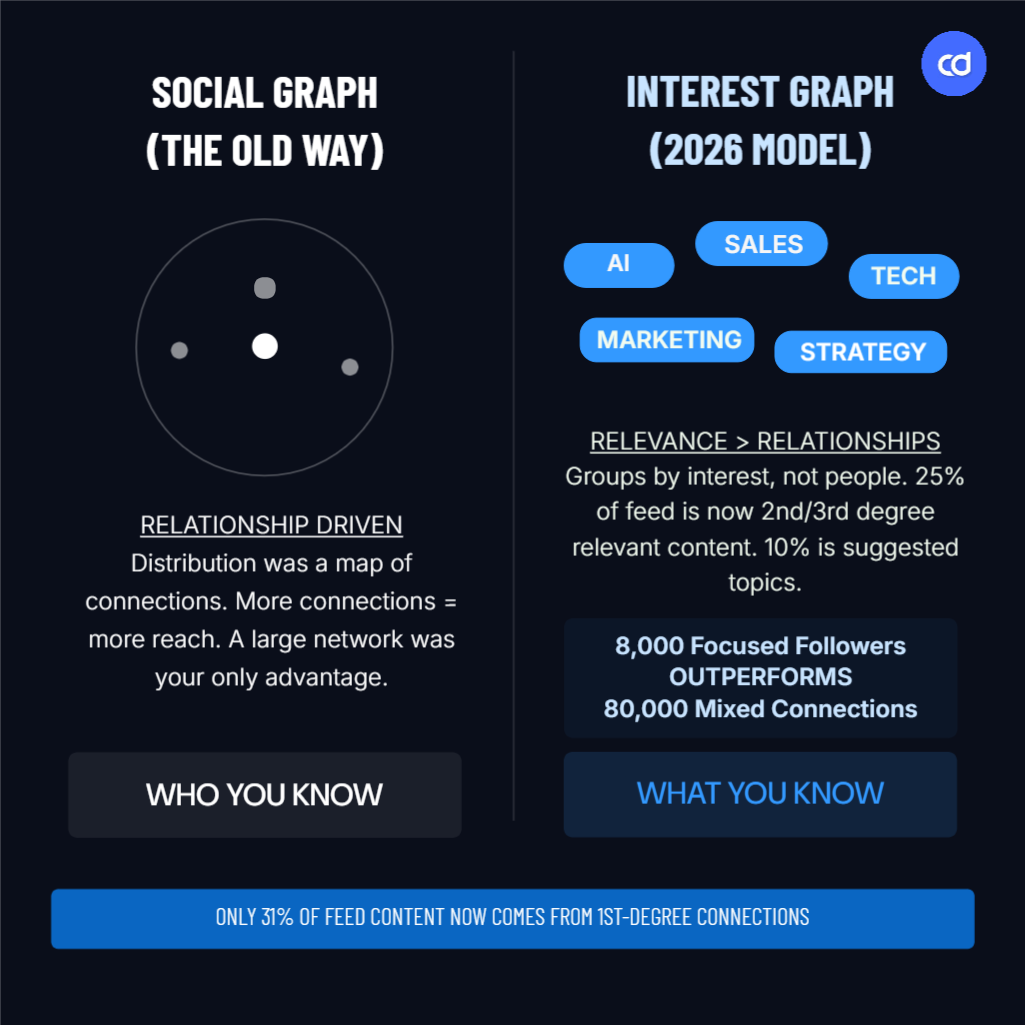
For most of LinkedIn’s history, content distribution was driven by the Social Graph – a map of who you are connected to. If you posted something and your connections engaged with it, LinkedIn showed it to more of your connections and their connections. Relationships were the primary distribution mechanism. More connections = more reach. A large network was a genuine advantage.
What the Interest Graph Is
LinkedIn has now moved decisively to an Interest Graph model. Instead of asking “who do you know?”, the algorithm now primarily asks “what are you interested in?” It groups people by topics, not by relationships. Relevance now comes before relationships.
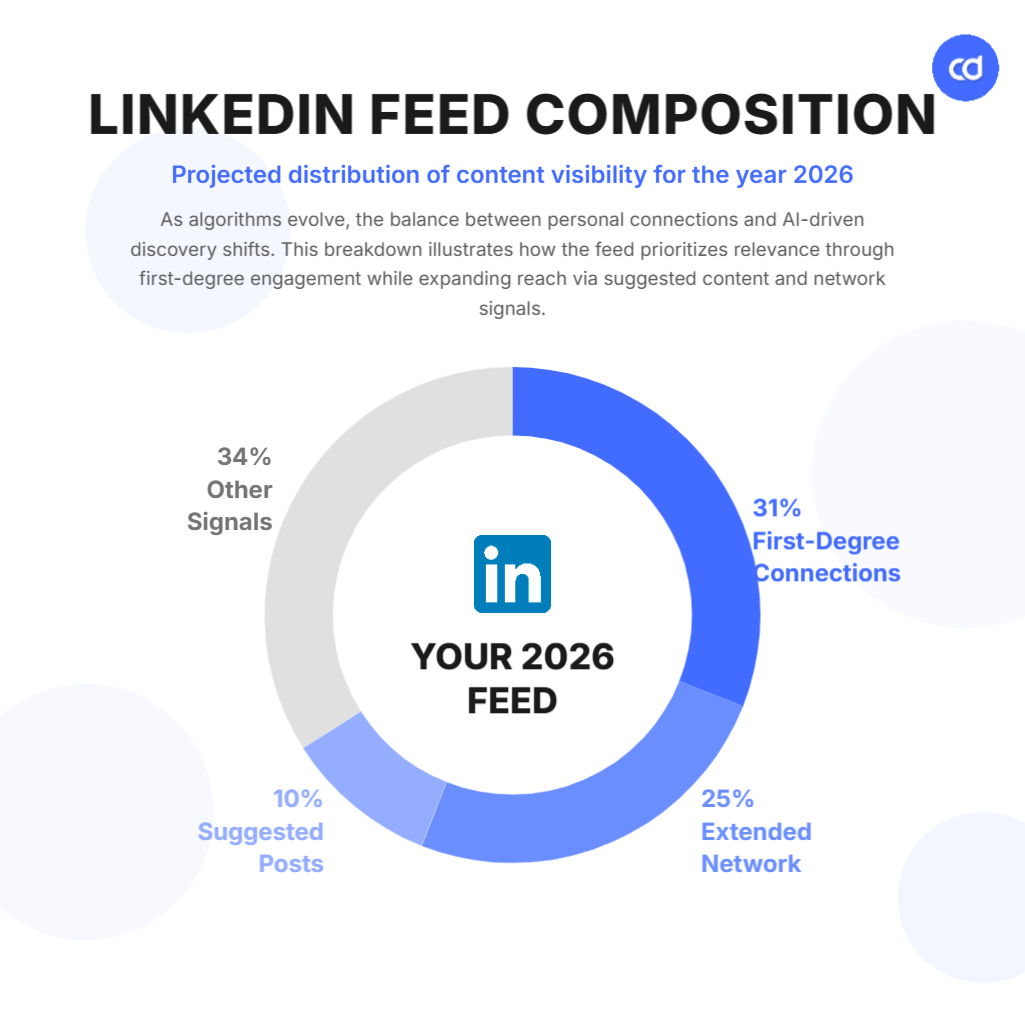
The practical consequence is significant. According to analysis of the 2026 feed composition:
- Only about 31% of the average LinkedIn feed now comes from first-degree connections
- Around 25% comes from second and third-degree connections the algorithm judges relevant
- Around 10% is Suggested Posts – content from people you have never interacted with, selected purely on topical relevance
The old playbook – grow your connection count, post to your network, ride their engagement – is now largely obsolete as a primary strategy.
An account with 8,000 highly focused, topically relevant followers can now consistently outperform one with 80,000 mixed connections. Follower count and reach have become structurally decoupled.
What This Means for You
Your content’s potential reach is no longer capped by your network size. It is now determined by topical consistency and demonstrated expertise. A first post by someone with 500 followers but deep subject matter authority on a niche topic can now reach thousands of people who have never heard of them. Equally, a creator with 50,000 connections who drifts across topics can find their reach collapsing.
3. How the Algorithm Filters and Distributes Your Content
When you hit publish, your content enters a multi-stage process before it reaches a significant audience. This pipeline is one of the core LinkedIn algorithm changes 2026 has refined – understanding each stage helps you make decisions that work with the system rather than accidentally triggering suppression.
Stage 1: Quality Filtering (Automated)
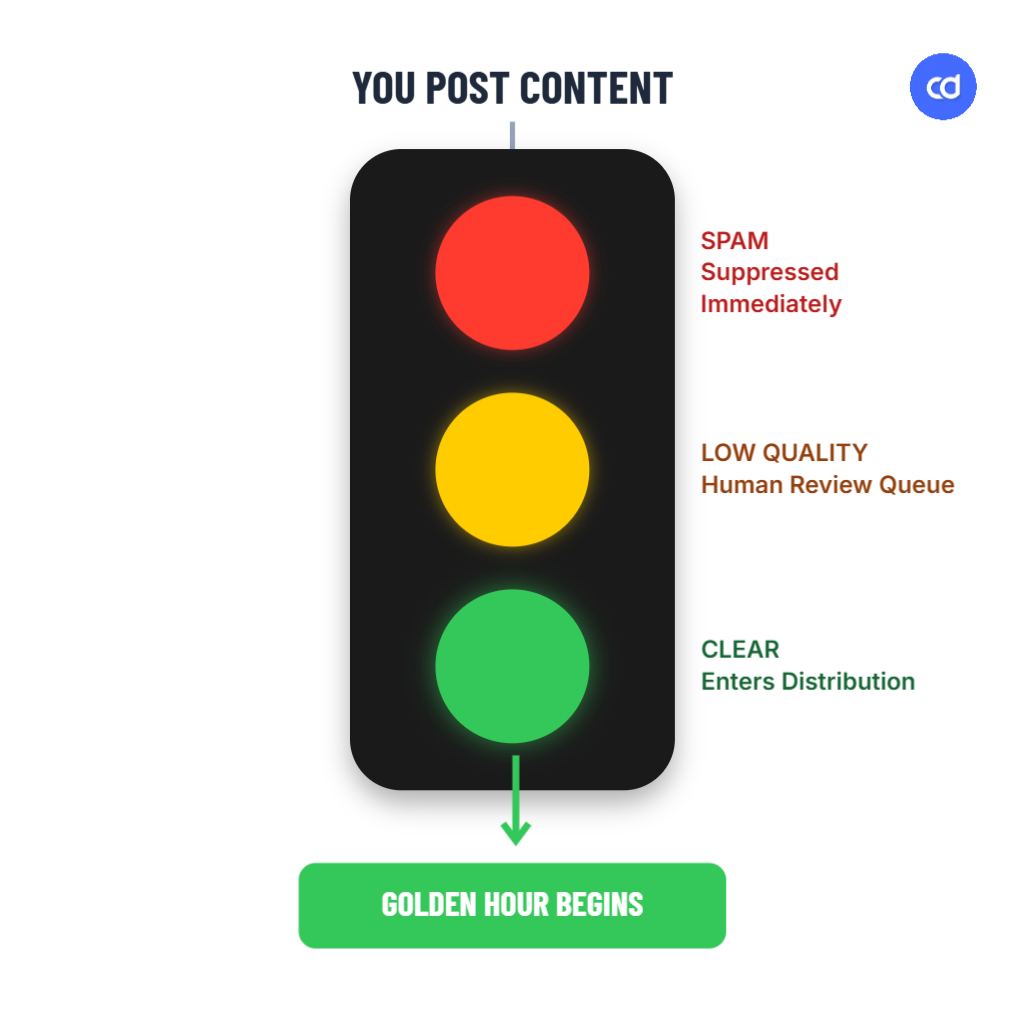
The instant you post, LinkedIn’s automated systems classify your content into one of three buckets: spam, low-quality, or clear. This happens before any human sees it.
According to LinkedIn’s spam detection documentation, what gets flagged as spam includes:
- Emoji or reaction polls designed to manufacture engagement (“React if you agree”)
- Posts misrepresenting LinkedIn platform features to drive reactions
- Chain-letter style content requesting shares
- Excessive, irrelevant, or repetitive tagging of unrelated people
- Posting more than once within a 12-hour window (can flag as low-quality)
Posts that are ambiguous – not clearly spam but not clearly excellent – get sent for human review before continuing distribution. This is why you sometimes see engagement on a post trickle in slowly for days: it may have been in the review queue.
Stage 2: The Golden Hour – Engagement Scoring
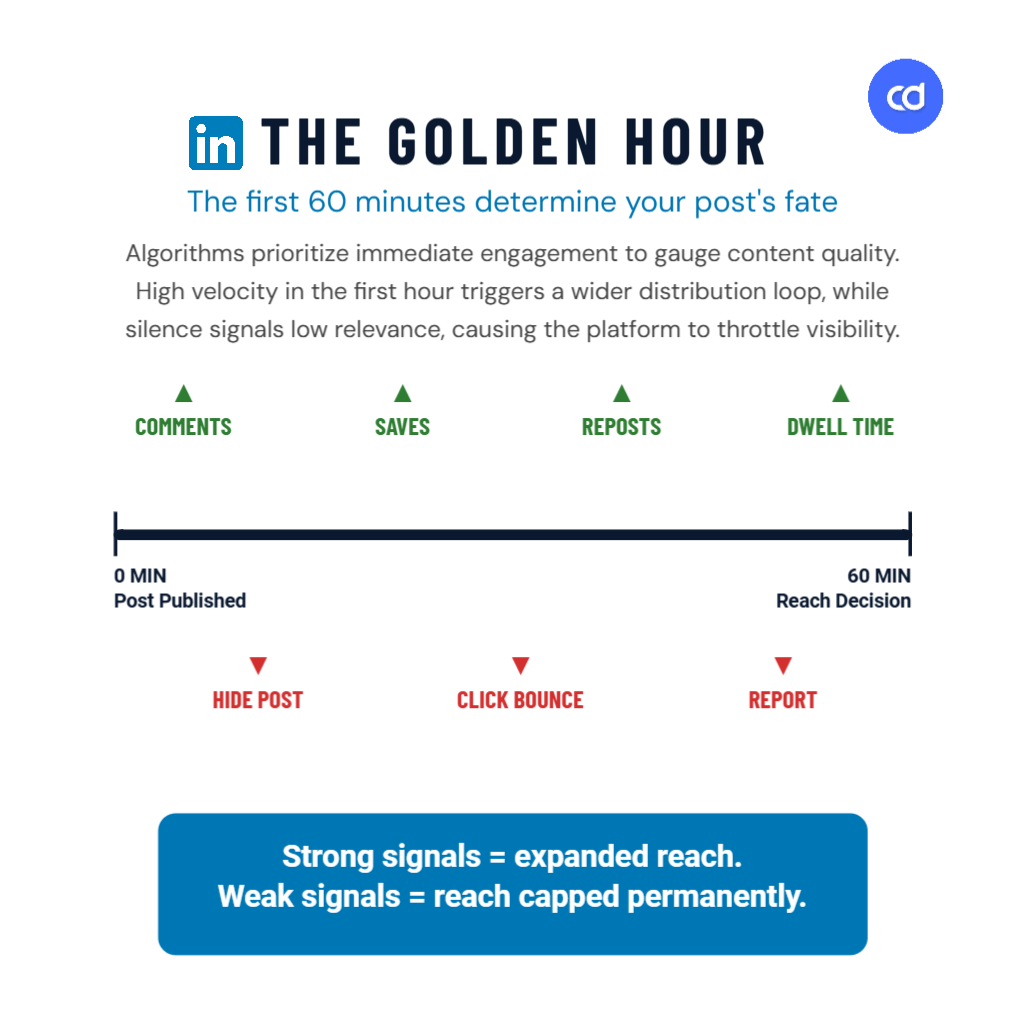
Once your post clears quality filtering, LinkedIn shows it to a small initial sample – estimated at 2-5% of your immediate audience. For the next 30-60 minutes (the “golden hour”), it closely monitors how that sample responds.
Positive signals it watches for:
- Comments – especially substantive ones that start threads
- Dwell time – how long people spend reading before scrolling away
- Saves – bookmarking signals lasting value
- Reposts – sharing to their own network
- Reactions – useful but weaker than the above
Negative signals that suppress distribution:
- Hiding the post from the feed
- Reporting it as inappropriate
- “Click bounce” – someone clicks, immediately leaves (signals a misleading hook)
- Rapid scroll-past without any interaction
Strong performance in Stage 2 triggers expanded distribution to second and third-degree connections and beyond. Weak performance limits the post’s reach permanently.
Stage 3: Interest Graph Matching and Sustained Distribution
If your post performs well in Stage 2, the algorithm does not just push it to more people randomly. It maps your content against the Interest Graph to find professionals across the platform who have demonstrated affinity for your topic – through their past engagement behavior, their profile details, the topics they follow, and the content they have historically found valuable.
A significant change that carried into 2026: posts no longer have a natural expiry window of 24-72 hours. LinkedIn confirmed in mid-2025 that it now resurfaces older posts – potentially weeks after the original publish date – when they match a user’s Interest Graph. Evergreen content can keep accumulating reach long after the golden hour closes. This is a meaningful shift in how you should think about content longevity.
4. The Ranking Signals That Matter Most in 2026
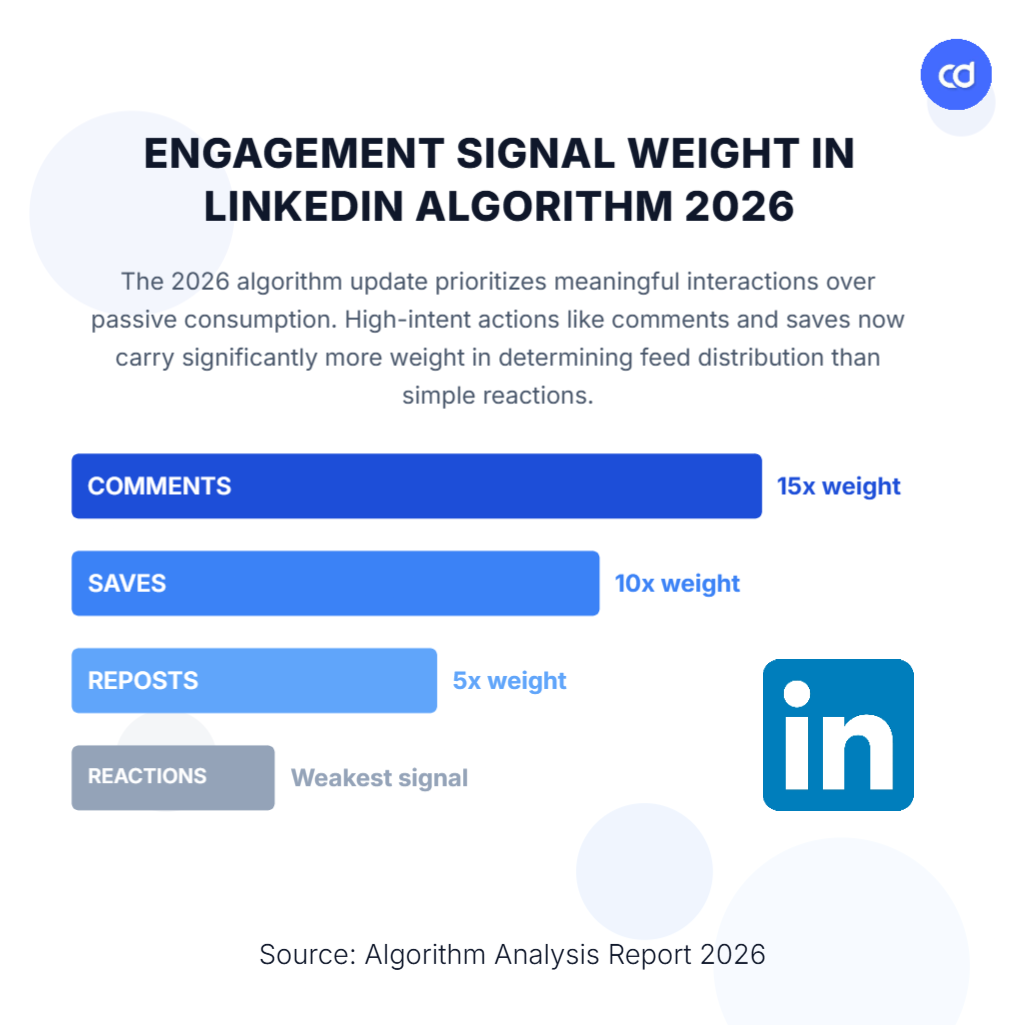
Not all engagement signals carry the same weight. LinkedIn uses a weighted system, and the weights have shifted significantly as part of the LinkedIn algorithm changes 2026 rolled out across the platform.
Comments (The Highest-Value Signal)
Comments are now the single most powerful organic signal in LinkedIn’s algorithm – and the gap between comments and other forms of engagement has widened considerably. Analysis from 2026 suggests comments carry roughly 15x more algorithmic weight than a basic like.
Critically, not all comments are equal either. The algorithm evaluates the quality and the commenter’s profile:
- A detailed, on-topic comment from a senior professional in your niche carries far more weight than a one-word comment from a random account
- Comment threads – back-and-forth conversations – trigger aggressive reach expansion
- Engagement pod comments (from unrelated professionals) can actually suppress distribution if the algorithm detects a mismatch between commenter expertise and post topic
The implication is clear: designing posts to generate genuine intellectual discussion – not just quick reactions – is the most direct path to algorithmic amplification.
Dwell Time (The Silent Signal)
Dwell time – how long a user spends on your content before scrolling – has become a primary quality signal in 2026, and it is the one most creators completely overlook because it leaves no visible trace.
LinkedIn’s system interprets extended reading as evidence that your content is genuinely valuable. A post that someone reads for 45 seconds before liking beats a post that gets 50 quick likes with an average engagement time of 3 seconds.
Data from 2026 analysis found that carousels (PDF documents) generate an average of 55 seconds of dwell time, compared to around 15 seconds for standard text posts. This is one of the core reasons carousels have become the highest-performing content format.
Practical dwell time optimization:
- Write long-form text posts that reward reading all the way through
- Use multi-slide carousel documents that require swiping through
- Open with a hook that creates a reason to keep reading, then deliver on it
- Avoid the bait-and-switch opener that gets a fast click but an even faster exit
Saves (The Underrated Signal)
Saves – when someone bookmarks your post to read later – are an extremely high-quality signal in 2026 and consistently underappreciated by creators. A save tells the algorithm your content has lasting value that someone wants to return to, beyond the moment of scrolling.
Content that earns saves tends to be educational, highly practical, or reference-worthy. Think frameworks, step-by-step breakdowns, curated lists that people will want to revisit, and data-backed analyses.
Reactions (Still Useful, But Weakest)
Reactions (likes, celebrations, insightful markers) confirm that someone saw and acknowledged your post. They are a valid positive signal, but they have become the weakest engagement metric in the 2026 algorithm compared to comments, saves, and reposts. A post that generates only reactions with no comments or saves is unlikely to receive extended algorithmic distribution.
Profile Authority (Your Track Record)
LinkedIn maintains an internal credibility score for each account based on its historical posting behavior, the quality of engagement it has received, and the professional caliber of people who engage with it. This acts as a multiplier – it expands distribution for established accounts with proven track records and limits reach for new or inconsistent accounts.
Building profile authority takes time. Analysis suggests 60-90 days of consistent, quality posting before measurable reach improvement, and 6-12 months to establish the kind of algorithmic authority that produces consistent beyond-network distribution.
5. Topic Authority and Knowledge Graph Validation: The New Gatekeepers
This is the section that most 2025-era LinkedIn guides have not covered – and it is arguably the most important concept for understanding reach in 2026.
What Is Topic Authority?
Topic Authority is LinkedIn’s internal credibility score for how strongly your profile and posting history associate you with a specific subject area. It is not a single number you can see anywhere. It is an inference the algorithm makes based on:
- Your profile: job title, skills listed, experience section, education
- Your content history: what topics you have posted about consistently
- Your engagers: the professional backgrounds of people who regularly interact with your content
- Your engagement behavior: what content you comment on and engage with as a reader
When you post about a topic that matches your established authority, the algorithm boosts distribution. When you post outside your recognized area, it may limit reach to protect users from low-authority content on that topic.
What Is Knowledge Graph Validation?
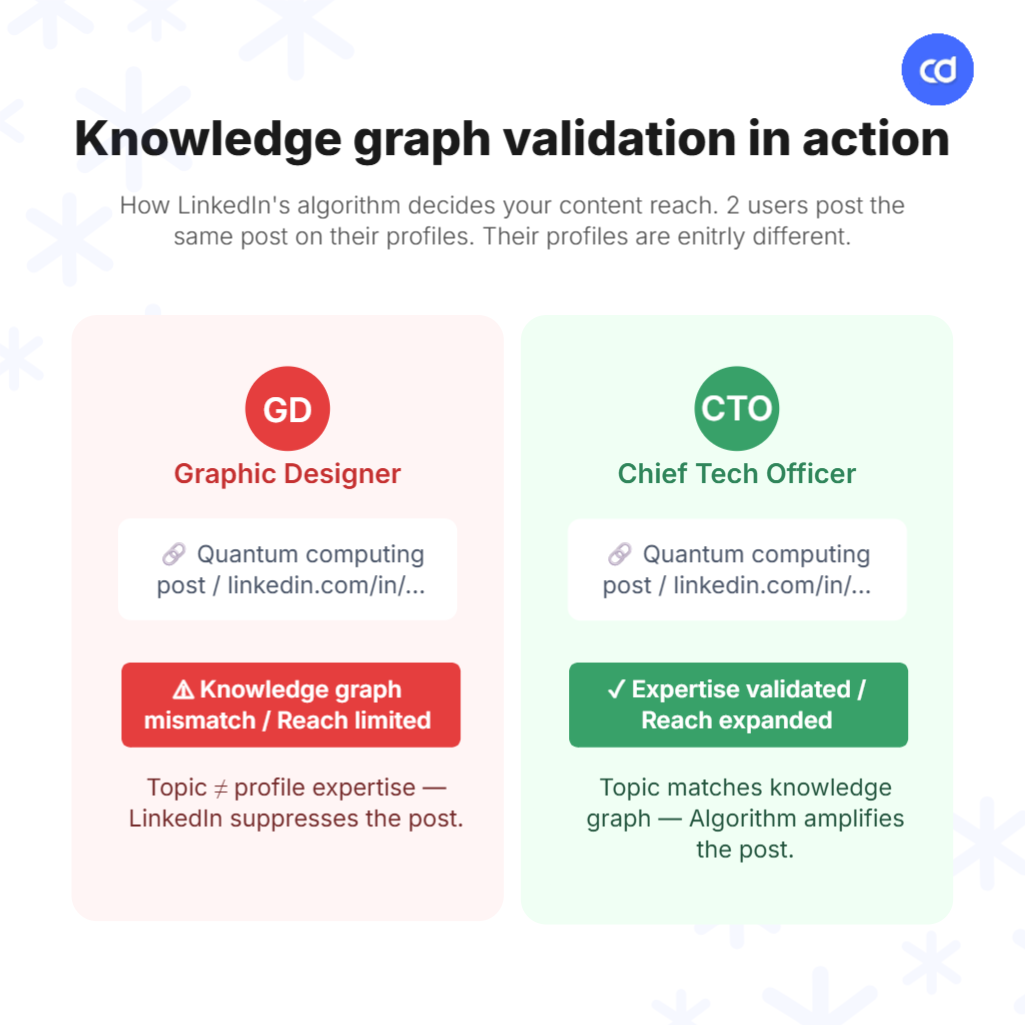
Knowledge Graph Validation is a specific 2026 addition. LinkedIn’s AI now actively cross-references your post topic against your profile data to check for expertise alignment before expanding distribution.
Two scenarios illustrate this clearly:
A graphic designer posts about quantum computing. The algorithm detects a mismatch in the Knowledge Graph and limits reach, partly to protect users from low-authority advice on a complex topic.
A Chief Technology Officer posts about quantum computing. The algorithm validates the expertise alignment and expands distribution, potentially surfacing the post to professionals with established interest in the topic across the Interest Graph.
This is why the advice to “stay in your lane” has never been more algorithmically sound than it is in 2026. Creators who tried to jump on trending topics outside their expertise in previous years might have gotten away with it. Now the Knowledge Graph makes it systematically punishing.
How to Build Topic Authority Intentionally
- Align your profile with your content. Your headline, about section, and skills should directly reinforce the topics you post about. There should be no ambiguity about your domain.
- Define your core 2-3 topics and stay within them. You do not have to post about one thing every day forever. But you need enough consistency that the algorithm can classify you. Aim to have 70-80% of your posts within a defined topic cluster.
- Engage within your niche as a reader. Commenting on other posts in your domain reinforces your topical signal and expands your visibility within that topic community.
- Grow your authority gradually, not abruptly. Creators who abruptly pivoted topics and went quiet on their original niche were “deprioritized out of existence” by the Interest Graph. If you need to expand your topic range, do it gradually over months, not overnight.
6. Content Formats Ranked by Algorithmic Performance in 2026
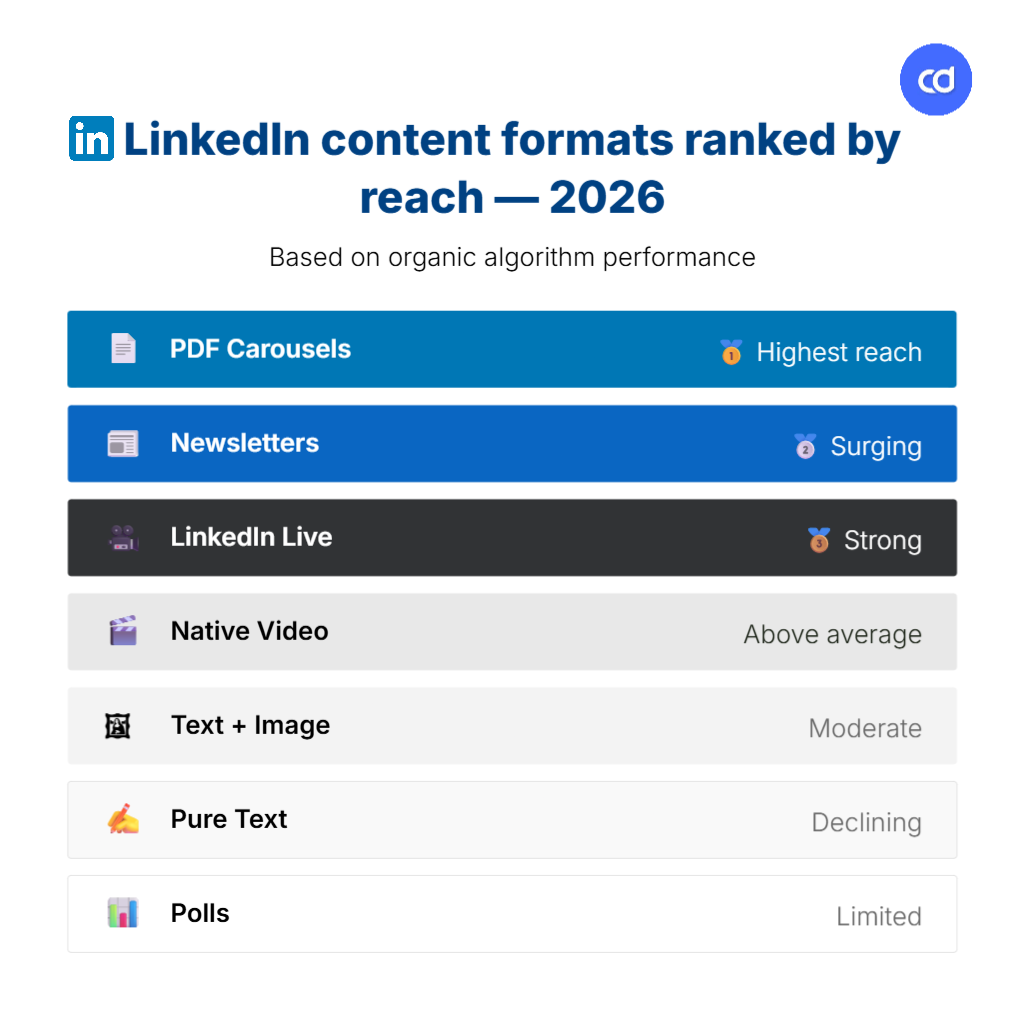
Not all post formats are treated equally by the LinkedIn algorithm. Format choice affects dwell time, engagement patterns, and topic classification. Here is where the formats rank in 2026, with context on why.
1. PDF / Document Carousels – Highest Organic Reach
Document carousels (uploaded as PDF files) remain the single highest-performing organic format in 2026. They generate 2-3x more dwell time than text-only posts because every swipe counts as a measurable interaction. The algorithm interprets each slide view as engagement, making the total dwell time measurement substantially longer than any other static format.
Additionally, carousels help the algorithm classify your content. The structured, multi-point format makes topic detection cleaner. A well-labeled 8-slide carousel on a specific topic sends a clearer signal than an open-ended text post on the same theme.
Best practices:
- 7-10 slides is the sweet spot – enough to drive dwell without losing people
- Design for mobile – over 58% of LinkedIn users are on mobile (Statista, 2025)
- Large font sizes, clean layouts – cluttered slides kill dwell time
- End with a question or call to action that prompts comments
- Keep visual branding consistent so your carousels build audience recognition over time
2. Newsletters – Unprecedented Distribution in 2026
LinkedIn Newsletters have quietly become one of the highest-reach formats available on the platform. The algorithm gives newsletters significant preferential treatment because LinkedIn is actively competing with Substack and Medium for long-form professional readership.
When you publish a newsletter, LinkedIn notifies all subscribers – and increasingly surfaces newsletter issues to relevant non-subscribers in the Interest Graph. Creators who publish regularly are reporting newsletters as their best-performing format in terms of net reach in early 2026.
3. LinkedIn Live – Highest Engagement Rate But Limited Reach
LinkedIn Live achieves engagement rates as high as 29-30% – dramatically higher than any other format. However, it requires preparation, a live audience, and consistency to build viewership. The format is most powerful for established creators with an active following, where live notifications can reliably pull an audience.
4. Native Video (Under 90 Seconds)
Native video – uploaded directly to LinkedIn, not linked from YouTube – continues to receive favorable treatment. Videos that auto-play with captions capture attention in silent-scroll mode. The algorithm favors videos that retain viewers past the first 10 seconds (a key drop-off point). Short-form video under 90 seconds with a clear hook in the first three seconds performs best.
Important: linking to a YouTube video is treated very differently from a native upload. External links take users off-platform, which LinkedIn penalizes algorithmically. Always upload video directly.
5. Text + Personal Image Posts
After several years of declining in favor of more visual formats, the classic text post with a personal or professional image has made a meaningful comeback in 2026. Authentic personal images – the author at an event, a screenshot of something real, a photo from a relevant work context – paired with strong written content perform strongly because they generate trust and personal connection, which drives comment depth.
6. Pure Text Posts
Text-only posts can still perform excellently – but they have to earn their reach through the quality of the writing alone. A strong hook, a clear narrative arc, a point worth engaging with, and a question at the end. The algorithm cannot give them the format-level boost it gives carousels or video, so the content itself has to work harder.
7. Polls – Use Sparingly
Polls generate easy engagement but are increasingly treated by the 2026 algorithm as a weak signal. The algorithm is better than ever at distinguishing superficial engagement bait from genuine discussion. Use polls occasionally for genuine research or opinion gathering, but do not rely on them for reach amplification.
7. What Actually Hurts Your Reach in 2026 (Including the Myths)
Some well-known LinkedIn “facts” from a few years ago are now outdated or flat-out wrong. The LinkedIn algorithm changes 2026 introduced have made several previously safe tactics actively harmful. Here is what actually hurts your reach versus what people incorrectly believe:
Confirmed Reach Killers
External links in your post body
Posts with links to external websites see estimated 18-60% less median reach than identical posts without links, depending on the source and measurement methodology. The reasoning is simple: LinkedIn does not want users leaving the platform. A post that drives traffic to your website may serve your business, but it works against what the algorithm is optimizing for.
The “link in first comment” workaround is also now penalized
This is one of the most significant 2026 updates that most guides published in late 2025 missed. As of early 2026, LinkedIn now also suppresses comments containing external links – with some analyses reporting visibility reductions of up to 80% for such comments. The workaround no longer works as a clean distribution fix. If you must share a link, put it in the post body and accept the trade-off, or reference the link directionally without embedding it.
Engagement pods with irrelevant commenters
Pods – groups of creators who agree to engage with each other’s posts – used to provide a meaningful boost by seeding engagement in the golden hour. The 2026 algorithm is now effective at identifying when commenters on your post have no professional relevance to your topic. Instead of a boost, pod activity from unrelated professionals can actually restrict your post’s reach by sending a confusing Interest Graph signal.
Posting too frequently
The 2026 algorithm rewards depth over volume. Posting multiple times per day, or more than once within a 12-hour window, can trigger quality flags. One excellent post per week consistently outperforms five forgettable ones in terms of reach, engagement, and Topic Authority building.
Abandoning a post after publishing (“post and ghost”)
Replying to comments within the first hour extends your post’s algorithmic lifespan by creating secondary engagement waves. Each reply restarts a mini-engagement cycle that the algorithm monitors. Ignoring your comments section after publishing leaves significant reach on the table.
Common Myths Now Debunked
MYTH: Hashtags significantly boost your reach
REALITY: Hashtag impact has declined dramatically. LinkedIn removed the ability to follow hashtags, eliminated hashtag fields from profiles, and retired Creator Mode hashtag topics. Posts without hashtags now outperform posts with hashtags by 5-10% in some analyses. The algorithm no longer primarily relies on hashtags to classify content – it uses semantic understanding of the text itself. If you use hashtags at all, use 1-3 niche, highly specific ones. Avoid broad generic hashtags entirely.
MYTH: Creator Mode gives you a distribution advantage
REALITY: Creator Mode was deprecated in March 2026. LinkedIn merged its features – the follow button, featured section, and LinkedIn Live access – into the standard account experience. The separate toggle no longer exists, and it no longer provides any algorithmic distribution advantage. The algorithm now treats all accounts equally based on behavior, not settings.
MYTH: Bigger networks always mean more reach
REALITY: Network size and reach have been decoupled by the Interest Graph shift. An unfocused audience of 80,000 can generate less reach than a focused audience of 8,000. What matters is not size but relevance density – how many of your followers and engagers share your professional domain.
8. Tactical Moves That Work With the Algorithm in 2026
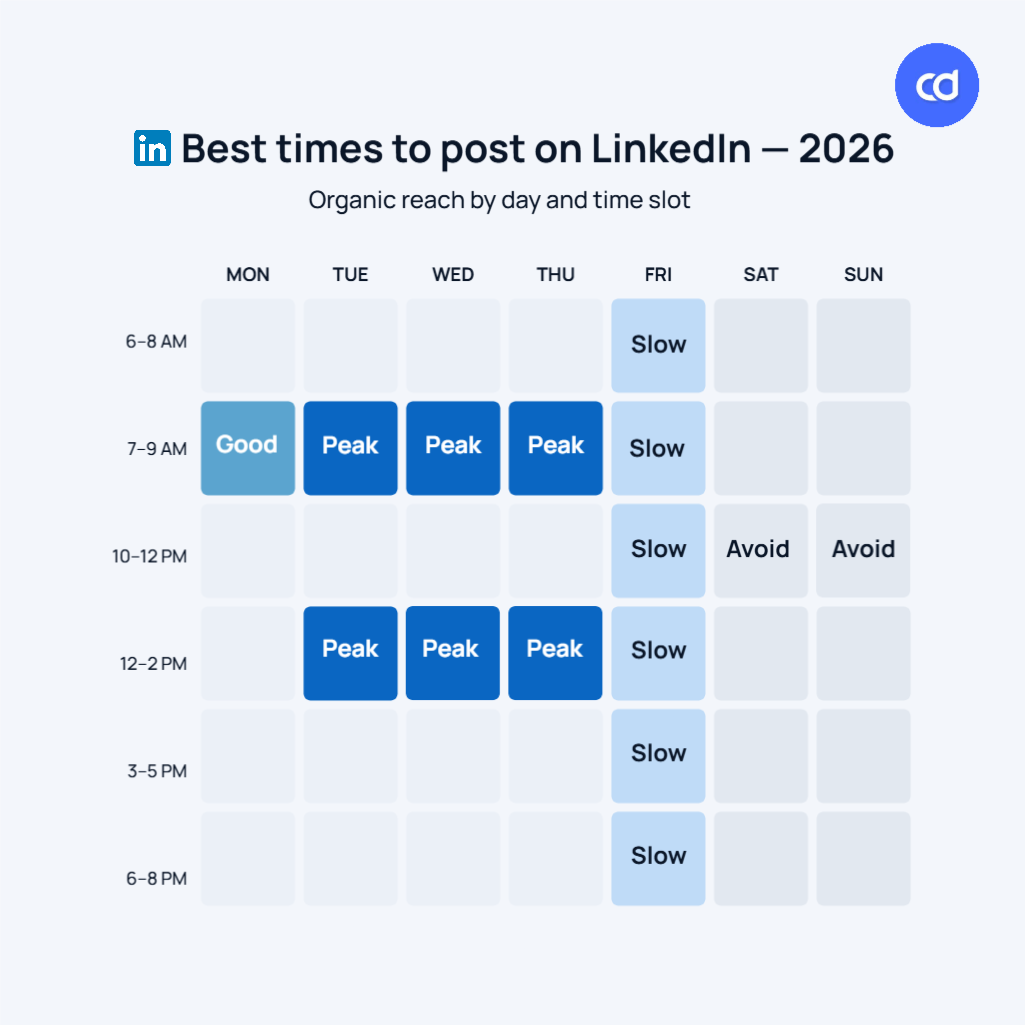
Understanding the mechanics is one thing. Translating them into daily decisions is another. These are the tactics that consistently move the needle based on the 2026 algorithm’s priorities.
Post at High-Engagement Windows
The golden hour means your post needs to hit an active audience immediately after publishing. The windows that consistently produce the strongest early engagement:
- Tuesday through Thursday: 7-9 AM in your target audience’s primary time zone
- Tuesday through Thursday: 12-2 PM (lunch hour browsing)
- Monday morning (for news and analysis content that sets the week’s agenda)
Friday afternoon and weekend posting consistently underperform for professional content.
Comment Before You Post
One of the highest-ROI activities on LinkedIn in 2026 is substantive commenting on other people’s content in your niche, before you post your own. This builds your visibility within your topic community, warms up the algorithm’s Interest Graph signals for your profile, and creates goodwill that often leads to reciprocal engagement on your own posts.
Daily commenting for 10-15 minutes before posting has been identified by multiple 2026 LinkedIn analysts as the highest-ROI activity available on the platform. Not creating more content. Engaging more deeply.
Engineer Your Hook
LinkedIn’s mobile feed shows only the first 1-3 lines of any post before truncating with a “see more” break. These lines determine whether someone stops scrolling or continues. A hook that creates genuine curiosity, states a counterintuitive truth, or immediately signals a high-value insight – and then delivers on that promise – is the single most learnable skill for improving LinkedIn performance.
Bait-and-switch hooks (dramatic opener, disappointing content) now backfire because of click bounce tracking. Your hook and your content need to be aligned.
Reply to Every Comment Within the First Hour
Each reply you make to a comment creates a secondary engagement event that the algorithm registers. Replying within the golden hour extends your post’s scoring window and creates the thread depth that signals a high-quality conversation. Practically: be available for the first 60 minutes after you publish.
Use Semantic Structure, Not Just Keywords
LinkedIn can now infer topics from the text of a post itself, without relying on hashtags or explicit labels. This means writing with depth and specificity in your domain naturally improves topic classification. Posts that use precise industry terminology, reference specific concepts, and demonstrate actual expertise get classified more accurately and distributed more precisely to the right Interest Graph nodes.
9. How to Build a LinkedIn Content System That Works in 2026
Understanding the algorithm is the foundation. Executing consistently – with the right formats, the right timing, and the right content – is where most people stall.
The creators and brands seeing consistent algorithmic growth in 2026 are not winging it. They have a system built around what the LinkedIn algorithm changes 2026 actually reward. Here is what an effective LinkedIn content system looks like at its core.
Define Your Content Pillars First
Topic Authority is built through consistency. Before you think about hooks, formats, or posting schedules, define your 2-3 core content pillars – the topics you can post about with genuine expertise and sustainable interest. Everything else flows from this.
If you are a sales leader, your pillars might be: enterprise sales methodology, sales team management, and the evolving B2B buyer journey. Every post should map cleanly to one of those pillars. Off-pillar posts should be the exception, not the rule.
Build a Content Calendar Around Format Variety
A balanced monthly LinkedIn content calendar in 2026 might look like:
- 4-6 text posts (including 1-2 personal story or opinion-based posts)
- 2-4 carousel documents on core topics
- 1 newsletter issue
- 1-2 native videos (optional, but high reward if done well)
- Daily commenting activity (5-10 substantive comments per weekday)
The calendar should ensure you are posting at roughly 2-3 times per week, never more than once per day, with at least one carousel format every 1-2 weeks.
Repurpose Intelligently
The same core idea can power multiple LinkedIn posts in different formats. A well-performing text post can become a carousel that breaks down its key points. A carousel can be distilled into a newsletter. A newsletter section can become a short video script. A high-performing post from six months ago – especially evergreen educational content – can be reworked and reposted, since a significant portion of your current audience has never seen it.
This is not laziness. It is efficient. The algorithm rewards the consistency and depth of your topic coverage – and repurposing your best insights across formats and time deepens that coverage without requiring an unlimited supply of new ideas.
Analyze What Actually Worked
LinkedIn Analytics provides reach, impression, and engagement data at the post level. The most valuable habit is a monthly review: which posts got disproportionate reach? Which formats generated the most comments? Which topics performed best? Let actual data – not intuition – guide where you invest content creation effort in the following month.
Look specifically for posts that continued to get impressions 2-3 weeks after publishing – these are your evergreen formats and topics, which are the ones worth doubling down on.
10. The LinkedIn Content Creation Challenge (And How to Solve It)
Understanding the LinkedIn algorithm in 2026 is one thing. Producing the kind of content it rewards – consistently, at quality, across multiple formats – is where the real work lives.
The algorithm in 2026 rewards:
- Consistent posting within a defined topic area
- High-quality visuals (particularly carousels) designed for mobile
- Content that aligns with your established expertise and brand voice
- Native formats that keep audiences on-platform
The barrier is that producing all of this manually – writing the long-form posts, designing the carousels, maintaining visual consistency, keeping a schedule, and staying on top of trending topics in your niche – is time-intensive. For most professionals and teams, it is where the system breaks down.
That is the exact problem Contentdrips is built to solve.
Writing LinkedIn Posts That Match Your Voice
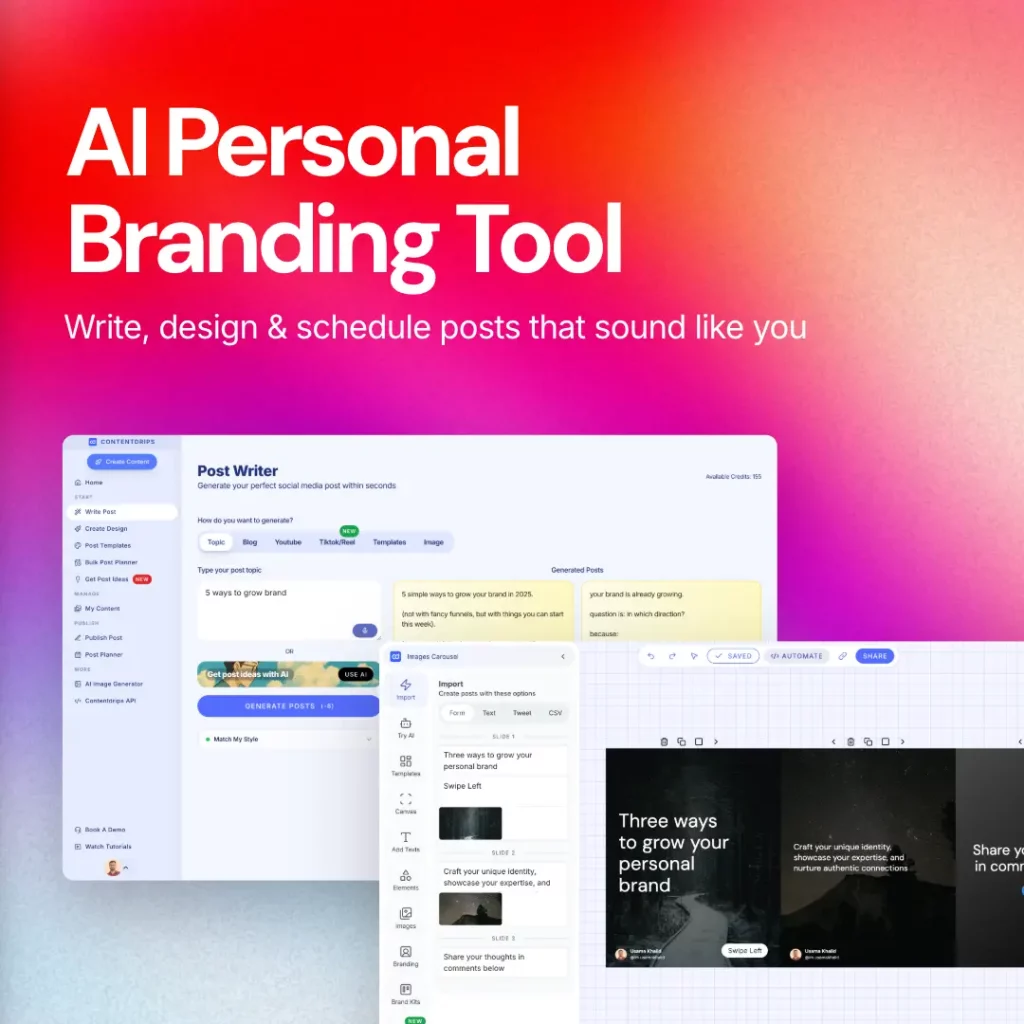
Contentdrips includes an AI post writer designed specifically for LinkedIn. You can generate posts from a topic, a blog article, a YouTube video, or from a bank of AI-generated ideas. The Match My Style feature learns from your past content and ensures that every generated post sounds like you – maintaining the consistency of voice and tone that builds recognition and trust with your audience over time.
Building Carousels Without a Designer
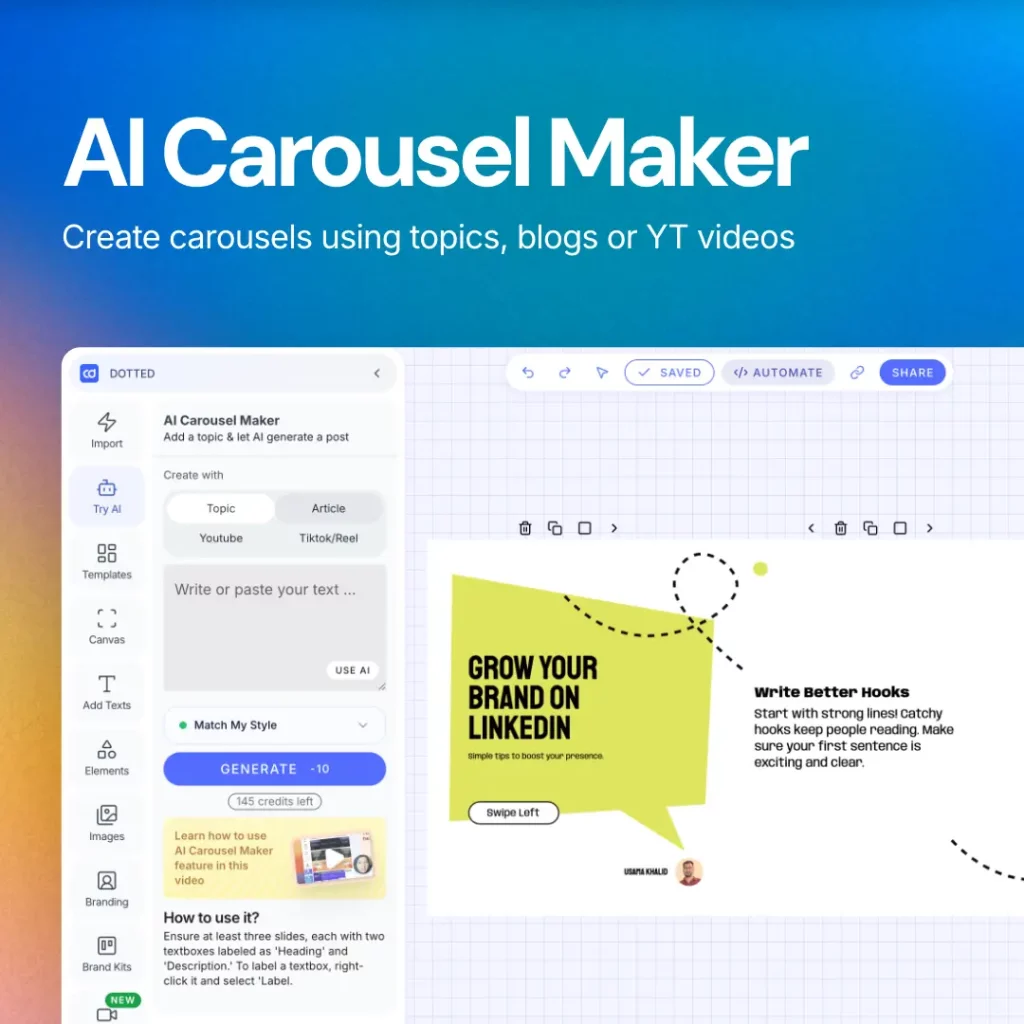
Carousels are the highest-reach organic format in 2026 – but most professionals cannot produce visually polished, mobile-optimized multi-slide documents at the pace the algorithm rewards. Contentdrips lets you generate carousels directly from topics, articles, or videos, apply your brand kit automatically, and export ready-to-upload PDF documents without any manual design work.
The AI Design Agent takes this further: describe the post you want in plain text, and the agent generates a fully designed visual – handling layout, typography, colors, and content. You can iterate with follow-up prompts and edit the result directly on the canvas.
Staying on Top of Trends in Your Niche
One of the most effective signals for timely engagement on LinkedIn is original commentary on industry news. Contentdrips includes a live trend search and RSS feed integration that surfaces what is trending in your niche, so you can turn trending topics into posts quickly – adding the original perspective and practical takeaway that the algorithm rewards.
Planning and Scheduling at Scale
The bulk post planner lets you create and schedule up to two weeks of LinkedIn posts in advance – written content and visuals together – so you can build the posting cadence the algorithm rewards without being chained to a daily content production loop.
Summary: The 2026 LinkedIn Algorithm in Plain Terms
If you take nothing else from this guide, take these core principles. They reflect everything the LinkedIn algorithm changes 2026 have been moving toward:
- The Social Graph is out. The Interest Graph is in. Network size no longer determines reach. Topic relevance and expertise alignment do.
- Topic Authority is now a gatekeeper. Post consistently within your defined area of expertise. Drift kills reach.
- The first 60 minutes decide your reach ceiling. Post at peak times, be present to reply, and seed genuine engagement early.
- Comments beat likes. Dwell beats comments. Saves are underrated gold. Optimize for depth of engagement, not volume.
- Carousels are the best format. Newsletters are surging. Native formats that keep people on-platform win.
- External links hurt you, including in the first comment now. Drive traffic thoughtfully, not reflexively.
- Creator Mode is gone. Hashtags are nearly irrelevant. Stop relying on tactics that no longer exist.
- Quality beats frequency every time. One excellent post per week beats five average ones.
- Engaging as a reader builds your algorithmic credit. Daily commenting on niche content is the highest-ROI activity on LinkedIn in 2026.
- Evergreen content has a longer shelf life than ever. Posts can resurface weeks later if they match a user’s Interest Graph profile.
The LinkedIn algorithm in 2026 rewards the things it always should have rewarded: genuine expertise, consistent value, and authentic professional conversation. The difference is that it is now technically sophisticated enough to actually enforce those standards.
Build your content system around those principles, choose the right formats, produce at quality – and the algorithm will work for you rather than against you.